



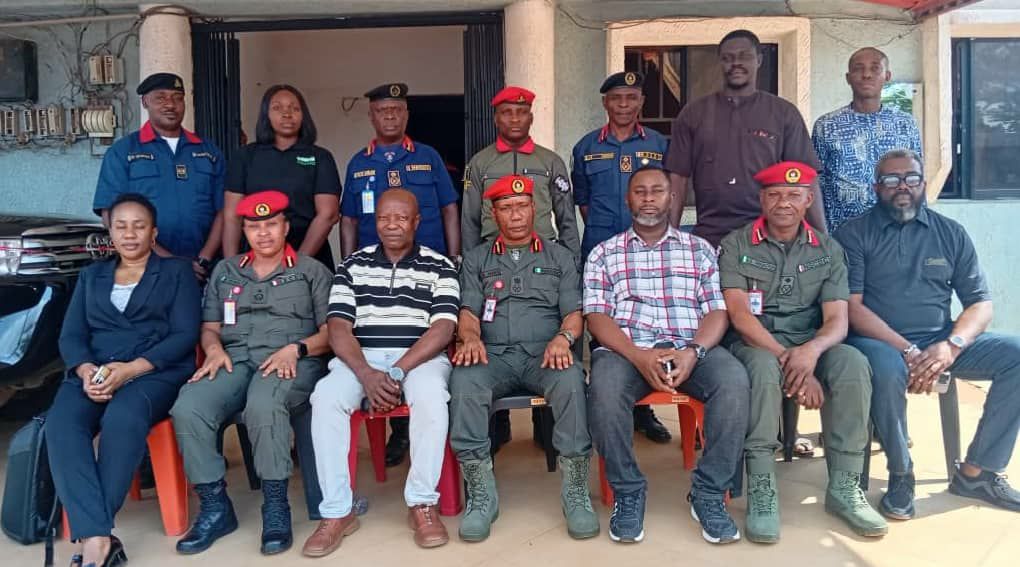
The Nigeria Security and Civil Defence Corps, Anambra State Command, has held a strategic engagement meeting with construction companies, contractors, and stakeholders over the rising incidents of fibre-optic cable damage during road construction across the state.
The meeting, which took place at the State Command Headquarters, Awka, on Wednesday, March 18, 2026, was convened in compliance with a directive from the Office of the National Security Adviser (ONSA) through the National Headquarters of NSCDC.
In his speech, Commandant Maku Olatunde, Anambra Commandant of NSCDC, noted that under the Designation and Protection of Critical National Information Infrastructure (CNII) Order 2024, telecommunication fibre infrastructure has been classified as Critical National Information Infrastructure.
The NSCDC boss cautioned that negligence leading to its damage will no longer be tolerated.
He highlighted telecom assets’ strategic importance, calling for vigilance, regulatory compliance, and cooperation between construction companies and telecommunication providers to prevent disruptions and losses.
According to him, fibre-optic cables are central to Nigeria’s digital economy, supporting communication networks, business operations, government functions, and emergency services. Hence, frequent and avoidable fibre cuts pose serious threats to public safety, national security, and economic stability.
The NSCDC State boss added that in most cases, destruction or vandalism of fibre-optic cables happens during road construction projects where excavations are undertaken without prior consultation, proper verification of underground facilities, or collaboration with telecommunication providers and the NSCDC.
He stressed that any damage arising from unauthorized excavation, construction activities, or failure to coordinate with relevant authorities is deemed a criminal act, and anyone found culpable will face prosecution and applicable sanctions as provided under the existing laws.
Commandant Maku urged all stakeholders to collaborate effectively in safeguarding these strategic assets, describing the meeting as a vital step towards building resilience in the telecommunications sector and preventing unnecessary disruptions.
In his contribution, Engr. Dr. Opara Emeka, the Federal Controller of Works, Federal Ministry of Works, Anambra State, frowned at the attitude of some telecommunication operators who are supposed to follow due process and approval in laying fibre-optic cables for neglecting to furnish his office with fibre-optic routes, and non-adherence to approved excavation and right-of-way procedures.
The meeting featured discussions on improving coordination, information sharing, and enforcing regulations to protect underground fibre installations. Stakeholders agreed to regular meetings and preventive measures to minimize infrastructure damage during road construction.
Participants acknowledged the meeting as productive, marking a significant step toward enhancing infrastructure protection and sustaining digital connectivity in Anambra State.
The meeting yielded crucial outcomes, including the prompt implementation of the “Call Before You Dig” protocol for all excavation projects statewide, setting up a unified notification and response system, creating practical guidelines for fibre-optic cable management, and enhancing cooperation among stakeholders, including state governments, telecom operators, regulators, and security agencies.
Key stakeholders at the meeting included the Controller, Federal Ministry of Works, Anambra State; senior representatives from mobile network operators including T2 Mobile (formerly 9mobile), Airtel Nigeria; professional bodies such as the Council for the Regulation of Engineering in Nigeria (COREN) and the Nigerian Society of Engineers (NSE); state government officials; as well as representatives of some construction companies in Anambra State.
