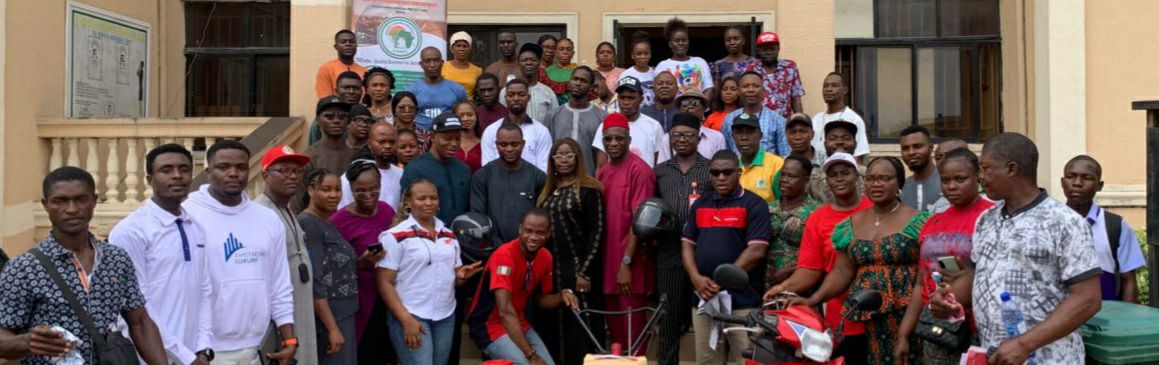





Anambra stakeholders championed bamboo as a high-value resource capable of reshaping livelihoods and tackling climate challenges.
The call came during the Anambra South Climate Smart Agriculture and Bamboo Entrepreneurship Programme held in Awka, with the theme “Sowing Seeds, Growing Futures,”
The event attracted academics, farmers, investors, policymakers, youth leaders and development partners, who aligned on unlocking new economic opportunities within agriculture.
Angel Network News (ANN) reports that the experts converged to promote a transition from subsistence farming to agribusiness anchored on innovation and sustainability.
The summit, convened by Chibuike Kas Obiwuzie, Youth Senator representing Anambra South in the Nigerian Youth Parliament, was organised in partnership with the Sahelian Institute for Bamboo Research and Entrepreneurship Development at Nnamdi Azikiwe University.
Chairman of the occasion and Vice-Chancellor of Nnamdi Azikiwe University, Prof. Ugochukwu Bond Stanley Anyaehie, represented by Prof. Kingsley Ubaorji, framed the discussion around human capital as the foundation of economic transformation.
He stressed that early exposure of young people to agriculture and climate awareness is key to building a resilient and productive society.
“As soon as they catch this vision early, then we are safe. But if they don’t, they will struggle,” he said, warning of the long-term consequences of neglecting youth engagement.
The Vice-Chancellor highlighted agriculture as a sector with untapped economic potential, particularly when linked to innovation and value chains such as bamboo production.
Prof. Anyaehie called for stronger collaboration among government, institutions, and private actors to build a sustainable food system capable of supporting a growing population.
The VC also raised concerns about insecurity in farming communities, noting that economic gains in agriculture cannot be sustained without deliberate efforts to protect farmers and their investments.
In his keynote address, former Commissioner for Agriculture in Anambra State, Forster Ihejiofor, presented bamboo as a strategic economic asset with the capacity to drive industrial growth.
Ihejiofor outlined the structural challenges facing agriculture in the state, including limited land, environmental degradation, and climate variability, but insisted that these constraints can be turned into opportunities through innovation.
According to him, bamboo stands out as a resource with both environmental and commercial value, offering solutions to erosion while simultaneously creating multiple streams of income.
“Bamboo helps control erosion, restores degraded land, and absorbs more carbon than many tree species,” he said, adding that its industrial applications span construction, furniture, textiles, packaging, and renewable energy.
Ihejiofor emphasized that unlocking these opportunities requires deliberate policy direction, including access to financing, incentives for investors, and land reforms that prioritize youth participation.
He noted that a fully developed bamboo value chain could significantly boost revenue generation, create jobs, and strengthen food security across the state.
Also speaking, the Director of Sahelian Institute for Bamboo Research and Entrepreneurship Development, John Ogbodo, reinforced the economic and environmental relevance of bamboo in today’s global context.
Ogbodo described the initiative as a timely intervention, given rising concerns over climate change and food insecurity, and stressed the need to align agricultural practices with sustainability goals.
He highlighted bamboo’s role in carbon absorption and its integration into agroforestry systems, noting that it offers a practical pathway toward greener production methods.
Beyond farming, he pointed to its potential in replacing plastic materials with biodegradable alternatives, thereby contributing to environmental protection while opening new business frontiers.
“We are planting seeds today not just physical seeds, but knowledge,” he said, urging participants to convert ideas into action, especially as the planting season approaches.
For the host, Chibuike Kas Obiwuzie, the programme was designed to spark a mindset shift one that redefines agriculture as a profitable and modern enterprise rather than a last option.
He emphasized that the initiative seeks to bridge the gap between policy formulation and grassroots implementation, while equipping young people with the tools needed to thrive in agribusiness.
Obiwuzie noted that involving students as active participants was a deliberate strategy to build future leaders in the sector.
“The future of our people, the security of our nation, and the prosperity of our youth are tied to the soil beneath our feet,” he said.
In his remark, Chairman of the Central Planning Committee, Franklin Ezeilo, described bamboo as an untapped “green goldmine,” particularly in addressing environmental challenges such as plastic pollution.
Goodwill messages from international stakeholders, including Alexander Gbedo and Dr. Muralidharan, echoed the need for Africa to leverage bamboo as a driver of climate resilience, industrialization, and circular economy development.
The event also featured technical sessions, field demonstrations, and the unveiling of farmer-focused guidebooks, signaling a shift toward practical implementation.
Across the summit, one message stood clear: with the right policies, investments, and youth engagement, agriculture—powered by bamboo—can move from subsistence to a thriving engine of economic transformation.