


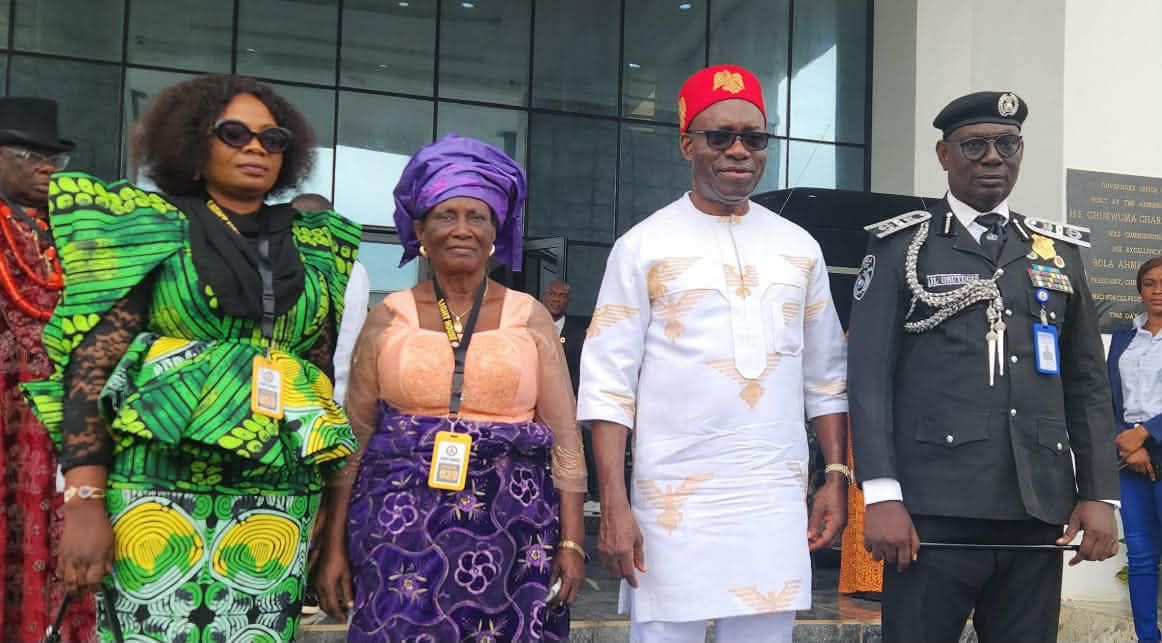
A major highlight of the Delta State Economic and Investment Summit in Asaba was the description of Governor Chukwuma Charles Soludo as the man who moves against the wind by Nigeria’s Vice President Kashim Shettima. This is indeed the truest definition of exceptional and transformational leadership, that is, the kind of leader that is transgressive in a very positive way.
It is in Soludo’s DNA to lead the way so that the people can follow his lead towards progressive ends. The oomph of Soludo is disruptive change, which entails moving against the wind in the pursuit of societal development. It is crucial to recall that Soludo’s first assignment on the day he was sworn in as Anambra State Governor was to go boldly into the then woebegone slum of Okpoko in Ogbaru Local Government Area and eventually turn the place into what is now called “New Heaven”. Soludo came to governance well-prepared with his People’s Manifesto, alongside the report of the 80-member Transition Committee he instituted and the document of the Anambra-2070 Committee he headed.
Governor Soludo said in his inaugural speech: “I know the lean financial base of the state. I know the limitations imposed upon a sub-national state such as Anambra by the peculiar structure of our federation. But here’s my promise: I will give it my all. I will work very hard every day, with you, to make Anambra proud. Every kobo of your tax money will be deployed to provide you maximum value.”
According to Soludo, he banks on “the plans, values, passion, and accomplishments of some of Africa’s liberation-cum-independence leaders such as Julius Nyerere, Kwame Nkrumah, Nelson Mandela, Patrice Lumumba, Nnamdi Azikiwe, etc.”
In moving against the wind, Soludo has courageously waged a war against rentier politics and politicians. Soludo rejects the so-called “stomach infrastructure” politics and will not eat the dividends of democracy. He sees politics as service rather than a job and preaches the old-school view that honesty is the best policy. Soludo remains unafraid to jump into terrains where even daredevils fear to tread. It is fresh in the memory how he dared all dangers as Nigeria’s central bank governor, as he reveals: “At a personal level, undertaking the banking revolution in Nigeria came with 19 written threats to me and my family, including physical attacks.”
The words of Soludo in his insightful essay entitled “The Purpose and Price of Disruptive Change” ring true, thus: “Disrupting the existing social order is dangerous. Beneficiaries of the current order are powerful enough to organise and fight back viciously to protect their privileges. On the contrary, the masses who are the ultimate beneficiaries do not organise themselves enough to act as a bulwark against the special interests. As things stand currently, we are between a rock and a hard place. To retain power within the context of short electoral cycles, politicians are afraid to undertake the necessary disruptive changes to guarantee long-term safety and prosperity for all. On the other hand, the existing trends are completely unsustainable, and the system is running out of time. Everyone is sleepwalking to the difficult place and praying that somehow a miracle will happen along the way.”
The kind of disruptive change he has brought to bear on Anambra State is akin to that wrought in Singapore, as Soludo once wrote: ‘I recently re-read Lee Kuan Yew’s book From Third World to First and can’t stop being inspired. The combination of competence and being driven by a higher purpose produced such transformational leadership that orchestrated a miracle in development. In one of his last speeches before his death, Lee Kuan Yew observed that he and his colleagues were prepared that even if they died trying to make Singapore great, they would have been happy to die for a worthy cause.”
In Soludo’s Anambra State, capital expenditure trumps the recurrent bill by as much as 79 per cent while a thousand roads are being constructed with well over 600 already delivered. Free education, free maternal and antenatal care, massive employment of teachers and medical personnel, construction of general hospitals, instituting the Solution Fun-City, etc. are all the rage.
Soludo did not need to come with a prepared speech to present at the Delta State Economic and Investment Summit in Asaba. He is, as always, well-prepared and therefore spoke extempore. He saluted the august gathering with “Greetings from Anambra, the Light of the Nation” and offered apologies for being 15 minutes late. In his words, “I was stuck in traffic in Onitsha. Today is Monday, and experiencing traffic in Onitsha on a Monday can only mean one thing: the Monday sit-at-home is over.” Ending the Monday sit-at-home issue is a classic Soludo achievement.
Soludo highlighted Anambra’s solidarity with “my prosperous neighbour, Delta State” and stressed that, from a macroeconomic standpoint, Nigeria has stabilised and is on the rise. He revealed that since becoming governor, he had not borrowed a single dime. Soludo pulled Anambra out of an ongoing World Bank loan, the NG-CARES programme, thus making Anambra the only state to do so.
In conclusion, the solution governor stated, “Previously, we faced a double jeopardy: we are a capital-scarce economy that, before 2023, suffered massive capital flight. Today, that trend has reversed. Net foreign exchange reserves now stand at a little over $40 billion, with gross reserves reaching about $52 billion – a dramatic rise from $3 billion in 2023. The exchange rate has become far more stable and predictable. Consequently, Delta, the broader Nigerian economy, and sub-nationals are well-positioned to attract foreign capital, including from across Africa, within a much more conducive macroeconomic environment. Secondly, we must work together. Delta is one of the 36 states of the federation, and while it is commendable for Delta to try on its own, true progress requires collaboration. Delta and Anambra are like twin cities, much like New York and New Jersey. We are actively building an economic free-trade zone powered by an Aerotropolis, and we must continue to synergise… Let us keep things simple and make investments a habit rather than a one-off event. We need a national consolidated Marshall Plan that translates these macroeconomic gains into tangible improvements, such as job creation and poverty reduction. We cannot create the jobs we desire if we continue to patronise foreign and imported goods. I am wearing Akwete fabric. My daughter introduced it to me in 2019, and it has since become my daily uniform. I understand that this choice has boosted both the employment and income of the women weavers in Akwete. I also learned that the First Lady recently announced a 2 billion Naira donation to the community to scale up production, promising to wear the fabric at her inauguration. If we all commit to wearing only Made-in-Nigeria goods, we will create more than ten million jobs.
Only the leader armed with the solutions can afford to move against it. Anambra and the nation have paid heed.
• Law Mefor, PhD, is Anambra State Commissioner for Information & Value Reformation
