





Poland’s long-running battle over its Constitutional Tribunal flared again after the court’s president and deputy were temporarily suspended, prompting President Karol Nawrocki to cut short a foreign trip and return urgently to Warsaw.
“The President must be in Poland”
“At a moment like this, the President must be in Poland. I am cutting short my flight to Senegal. I am returning,” Nawrocki said.
The tribunal announced that its president, Bogdan Swieczkowski, and vice-president Bartlomiej Sochanski had been ordered to take a break from their duties. Judge Anna Korwin-Piotrowska, described as the longest-serving judge recognised by the court’s current leadership, was placed in charge.
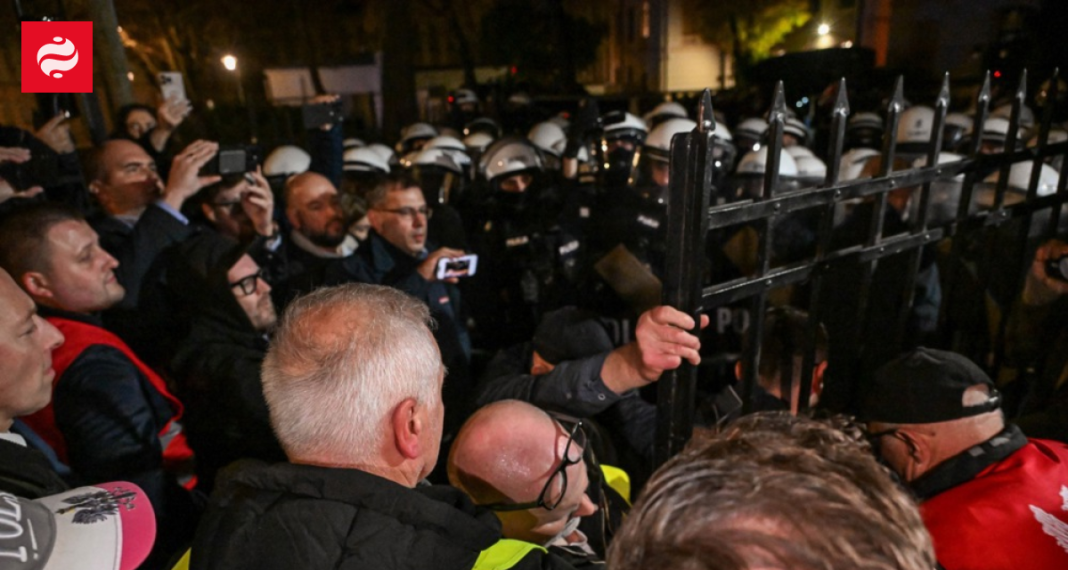
Judge Anna Korwin-Piotrowska announced on Friday the temporary suspension of tribunal president Bogdan Swieczkowski and his deputy Bartlomiej Sochanski. Police were deployed around the building as opposition supporters protested.
“Coup d’etat” versus “rule of law”
Prime Minister Donald Tusk’s government described the move as part of efforts to restore the rule of law. Opposition figures, including members of the Law and Justice (PiS) party, rejected that account, accusing the authorities of a “coup d’etat”.
Nawrocki, who is politically aligned with the previous PiS administration, went to the tribunal after returning and said constitutional order had been violated.
Dispute dates back to 2015
The conflict goes back to 2015, when PiS came to power and installed judges in posts that the previous parliament had already filled. The judicial overhaul that followed drew sharp criticism from the European Union. In 2021, the European Court of Human Rights ruled that irregularities in one judge’s appointment violated the right to a court established by law.
After Tusk’s coalition returned to power in 2023, it moved to reverse the changes. In 2026, parliament elected eight new judges, but Nawrocki refused to swear in five of them. The tribunal’s previous leadership also blocked the new judges from taking up their duties, despite earlier European Court of Human Rights demands that they be allowed to serve.
Work partly paralysed
Tusk’s government maintains it is acting to restore judicial independence. The opposition insists the suspension amounts to unlawful interference by the executive in a judicial body.
The standoff has left parts of the tribunal’s work paralysed and deepened the wider confrontation between the government, the president and the opposition.
