





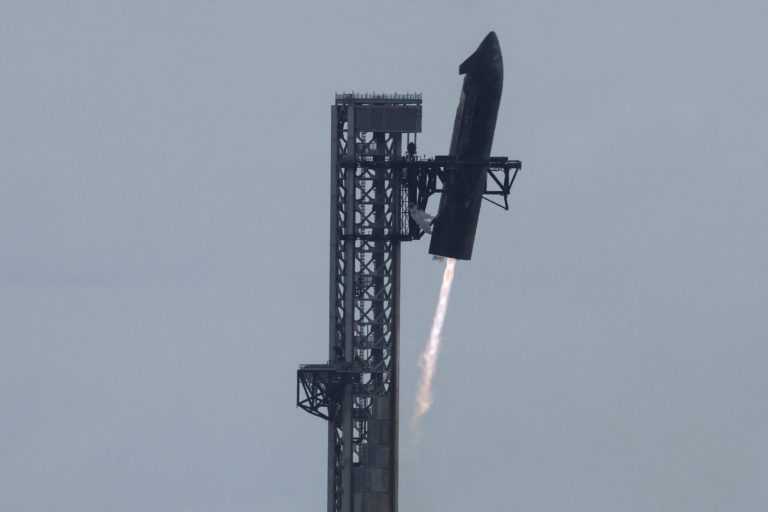
SpaceX successfully caught its Starship spacecraft with the mechanical arms of a launch tower on Saturday after a 22-hour journey in orbit, marking the first time an orbital rocket’s upper stage has returned to Earth and been recovered upright by a ground system.
The achievement came during Flight 15, which lifted off on Friday from Orbital Launch Pad 2 at the company’s Starbase facility in South Texas using Super Heavy Booster 22 and Ship 42. All 33 Raptor engines ignited at liftoff.
While the upper stage completed its mission, the Super Heavy booster failed to return to the launch site. Its engines shut down earlier than planned, prompting an abort. The vehicle was redirected toward the Gulf of Mexico, performed a landing burn, and then activated its flight termination system. SpaceX described the outcome as an offshore splashdown; other accounts reported an explosion before it reached the water. The company has not yet released a full explanation for the early engine shutdown.
The Starship upper stage completed 14 orbits at an altitude of about 165 miles (265 km) and deployed 26 Starlink satellites before re-entering the atmosphere and being caught by the tower’s “chopsticks” arms on Saturday, November 14.
SpaceX called the catch “an incredible achievement.” Google Chief Executive Sundar Pichai said the moment “still felt like science fiction.”
The recovery builds on SpaceX’s earlier success catching a Super Heavy booster with the tower arms in October 2024. Previous Starship upper stages had returned to the ocean. Catching the orbital stage is considered more demanding because it must endure high-speed atmospheric re-entry after circling the Earth, unlike the booster which returns within minutes of launch.
Rapid reuse of both stages is central to SpaceX’s goal of sharply reducing the cost of spaceflight. The company aims to recover, refuel and relaunch the vehicles with minimal turnaround time. Questions remain about the durability of the spacecraft’s heat shield and engines under repeated flights.
The progress also carries implications for NASA’s lunar programme. The U.S. space agency has contracted SpaceX to develop Starship as a lunar lander, with a crewed Moon landing targeted as early as 2028. Multiple orbital refuelling flights would be required before any lunar mission.
Flight 15 was the 15th full-scale Starship test since 2023 and only the second to reach orbit. SpaceX has not yet said whether the recovered spacecraft is ready for another flight or how soon it could be reused.
