


A former Emir of Kano, Muhammadu Sanusi II, has told presidential aspirants that enormous challenges await them as Nigeria will be in a deeper crisis in 2023.
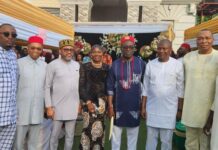
He spoke in Abeokuta, Ogun State, yesterday at a reception for him (Sanusi) as part of activities marking the 80th birthday of Babanla Adinni of Egbaland, Chief Tayo Sowunmi.
The former governor of the Central Bank of Nigeria also said Nigeri “is living on extra time”
He said: “To be honest, we’re living on extra time. In 2015, we were in a deep hole. In 2023, we’ll be in an even much deeper hole than in 2015.
“The challenges facing all those people who are struggling to be president, I hope they understand that the problems that they’re going to face are multiples of the problems that we were faced in 2015 and all of us have to be ready for difficult decisions and if they’re not taken, we’re all going to pay for it.
“But the solution is not for all of us to jump into politics. This country needs good politicians, it needs imams and pastors and bishops who are going to stand up and remind them (politicians) of the fear of God. It needs technocrats who are going to critique their policies, it needs traditional rulers who are going to speak as the conscience of the people, everyone has a role to play and we should try to play that role to the best of our ability.”
Sanusi also denied eyeing the presidency in 2023, saying he was contented being spiritual leader of the Tijaniyyah sect.
He said he had served in various capacities both in past and present “and I’ll forever be grateful to Allah.”
According to him, joining politics amounts to setting aside what “God has given me to look for something else.”
Sanusi, however, said that as a Muslim, he could not determine what the future holds for him.
He said: “People don’t understand the role we play as traditional rulers, as religious leaders that they think you should go and be a governor, or be a president. To be honest, I think that the role I play can be more important than that of the president, it is different, it has a different content.
“But to be Khalifa Tijaniyyaa of Nigeria is an office that personally, given the choice between that office and the presidency, I’ll choose that office.
“I thank Allah that as Emir of Kano and Khalifa of Tijaniyyaa, He has given me traditional-religious authority over God knows how many million people across the West African region and He has also blessed me with authority in my personal capacity that people tell me that they accept that authority because of who I’m not because of the position.
“I tell people when you tell me to go to politics, you’re telling me set aside one type of authority and look for another type of authority. Set aside the one that God has given me to look for something else.
“In this same life, God has made me governor of Central Bank, He has made me Emir of Kano, He has made me Khalifa of Tijaniyyah, what am I looking for?
“This is not to say that I’m retiring from service, constantly, life has to be about service and leadership has to be about service and that service involves obviously doing whatever is in my power to do. It involves speaking from conscience to those in authority.”
Earlier, Segun Sowunmi, who spoke on behalf of the family, had asked if Nigeria should be expecting a future president in Sanusi.
Nigerian politicians put the cart before the horse – Kari
Commenting, an associate Professor of Political Sociology, University of Abuja, Dr Abubakar Umar Kari, said: “ it is the nature of Nigerian politicians to put the cart before the horse.
“Ordinarily those who aspire for positions should first tell the people their plans, should state what they will do differently if given the opportunity, etc. In this clime, people crave power for its own sake and only begin to think of what to do after they get the elective position. Plans and programmes are no priority.
“But then, Nigerian electorates do not care about a candidate’s or a party’s manifesto or plans or programmes. Persons get elected often not account of what they can offer or do, but for sundry – mainly primordial – reasons such as the candidate’s region, religion, ethnic group or capacity to compromise the electoral process. Politicians know this fact only too well. That is why they bother less about elaborate plans, manifestos or programmes.
“Even those who have such plans, they do so simply to fulfill all righteousness, not that they believe in or stand by the plans or even intend to implement them if and when they get there.”
