



…Push for gender equality in politics gains momentum
Ahead of the 2027 upcoming elections, the push for gender equality in politics is gathering pace in Anambra State, as stakeholders intensify calls for increased inclusion of women in governance and decision-making processes.
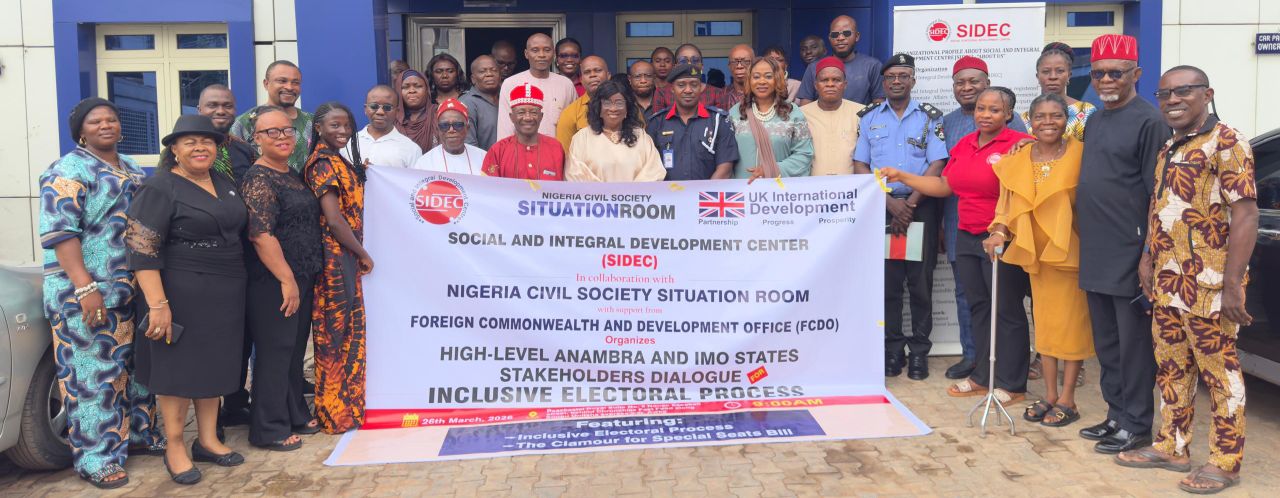
This renewed momentum was evident at a one-day high-level stakeholders’ dialogue on inclusive electoral processes organized by the Social and Integral Development Centre (SIDEC), a non-governmental organization committed to promoting equity and participation in governance.
The event marked the conclusion of Project IMPACT—Inclusive Mobilization for Participation, Advocacy, and Civic Transformation—implemented in collaboration with the Nigeria Civil Society Situation Room, with support from the United Kingdom’s Foreign, Commonwealth and Development Office (FCDO) in Anambra and Imo states.
Participants at the dialogue emphasized that achieving gender equality in politics requires more than advocacy, noting the need for deliberate strategies, structural reforms, and sustained engagement by women and supportive institutions.
They stressed that while women make up a significant portion of the population, their representation in elective positions remains disproportionately low.
A lecturer at Nnamdi Azikiwe University, Awka, Prof. Dennis Aribodor, urged women to move beyond complaints and embrace organization as a tool for political advancement.
He noted that bridging the gender gap in politics would require a comprehensive approach, including grassroots education, capacity building, and strategic alliances.
According to Aribodor, women must leverage their numerical strength and collaborate with credible organizations to achieve their political ambitions.
He also highlighted the need to address financial barriers, particularly the high cost of obtaining expression of interest forms, which often discourage women and young aspirants from contesting elections.
Adding her voice, Prof. Ogugua Ikpeze, a gender equality advocate and former Dean of the Faculty of Law at Nnamdi Azikiwe University, described the current political system as exclusionary.
She argued that the high cost of political participation limits access to leadership positions and undermines the quality of governance.
Ikpeze called for reforms, including tying nomination fees to the national minimum wage or eliminating them entirely to ensure a level playing field.
She also advocated legislative measures to address broader structural barriers affecting women, youth, and persons with disabilities.
In his remarks, Prof. Uche Collins Nwogwugwu, Director of the Institute of Social Policy and Strategic Studies at NAU, emphasized merit and competence as key factors in leadership selection.
He maintained that individuals who distinguish themselves are more likely to be considered for leadership roles, regardless of gender, stressing that excellence remains a critical pathway to political relevance.
Speaking, SIDEC’s Executive Director, Mrs. Ugochi Agalaba-Ehiahuruike, explained that Project IMPACT was designed to foster inclusive governance by ensuring equal opportunities for all, including women, youth, and persons with disabilities.
Agalaba-Ehiahuruike noted that the initiative has recorded encouraging outcomes, particularly during the November 8, 2025 governorship election in Anambra State.
She added that efforts are ongoing to develop strategies that will further enhance women’s participation in upcoming local government elections and the 2027 general elections.
In their separate submissions, stakeholders at the event called for the creation of a more enabling political environment, including the introduction of quotas for women, reforms of existing laws, increased participation in political party activities, and legal backing for the Special Seats Bill.
Angel Network News (ANN) reports that the dialogue attracted a broad spectrum of participants, including political actors, traditional leaders, academics, civil society organizations, youth groups, and media practitioners.
It featured panel discussions on inclusive electoral processes, a review of achievements under Project IMPACT, and strategies for sustaining progress.
Highlights of the event included the unveiling of the Project IMPACT Baseline Study Report and the presentation of an award to the Anambra State Commissioner of Police, Ikioye Orutugu, represented by CSP Harrison Anekwe, in recognition of the peaceful conduct of the 2025 governorship election.
With growing advocacy and coordinated efforts, stakeholders expressed optimism that the drive for gender equality in politics in Anambra State will continue to gain traction in the years ahead.