





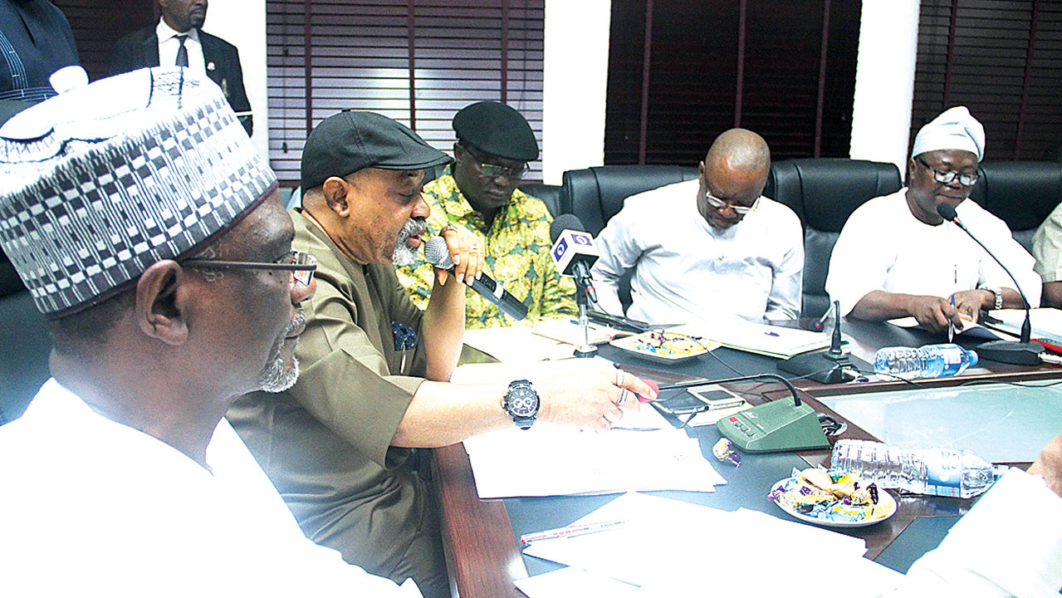
Last week, this column intervened in the ongoing ASUU strike under the rubric of ASUU’S Stroke, in which it called on ASUU to call off the strike in the interest of the health of the public universities which have tragically been under lock for more than six months, and ASUU members, who have not been paid their salaries for months. Since that intervention, the new buzz is that the federal government will implement the law on “no work, no pay,” hence another immediate intervention.
The “no work no pay” law is provided by Section 43(1)(a) of the Trade Disputes Act, 1976. It provides: “Notwithstanding anything contained in this Act or in any other law-(a) where any worker takes part in a strike, he shall not be entitled to any wages or other remuneration for the period of the strike, and any such period shall not count for the purpose of reckoning the period of continuous employment and all rights dependent on continuity of employment shall be prejudicially affected accordingly.”
If the above law is strictly applied, members of ASUU would not be entitled to salaries for the more than six months they have been on strike, and the period would be discountenanced from the period of service, with so many other consequences, almost ad infinitum. As a countermeasure, ASUU has also given notice that if the “no work no pay” policy is implemented, they would also not deal with any outstanding academic work arising during the period of strike.

By implication, ASUU said they would ignore pending students’ work for that period, including outstanding examinations and unmarked scripts. They would also discountenance teaching outstanding courses, and doubling down on lectures, to make up for the lost time. ASUU members would also discountenance the pending admissions, even as another batch of students would sit for the Unified Tertiary Matriculation Examination (UTME), early next year. In fact, they threatened that final year students who are on the verge of graduation would suffer the consequences of the policy, as well.
The diatribe has developed into a ‘tit for tat,’ and like the proverbial statement, ‘where two elephants fight, the grass suffers.’ In this instance, while the nation is paying a huge cost for the dislocation of the academic year of majority of her public universities, it is students that are suffering immeasurably in the fight between the federal government and ASUU. It is better imagined what would happen to the thousands of students who would be further dislocated by ASUU’s recent threat, and many of them could derail permanently.
In the contest for public sympathy, the federal government seems to be having an upper hand. Many have erroneously believed the false tale by the Minister of Education Mallam Adamu Adamu that all the demands of ASUU have been met, and the only outstanding issue is the payment of outstanding salary for the strike period. It has since come out that what the federal government offered were mere promissory notes that it would implement the demands next year, which ASUU has said is no different from what has been happening since the 2019 agreement was reached.
Just like his predecessors, the Buhari government has refused to implement the Memorandum of Agreement reached with ASUU. Prior to the 2019 agreement, there were those of 2009 and 2017, and the 2013 Memorandum of Understanding. Each of them never translated to terms of contract of employment, and as such remain unenforceable, except as it pleases the federal government. As stated by the Court of Appeal in Nigeria Deposit Insurance Corporation vs Obaende (2002) F.W.L.R. Pt. 116, pg. 944: “The enforceability of collective agreement is by agreement. Collective agreements, except where they have been adopted as forming part of the terms of employment, are not enforceable. The enforcement of such an agreement is by negotiation between the parties.”
According to ASUU, the federal government has even refused to sign any formal binding agreement with the union, beyond the Memorandum of Understanding, which is unenforceable. Again, in U.M.T.H.M.B vs Dawa (2002) F.W.L.R. Pt. 108, pg. 1419, the Court of Appeal held: “Where there is a written contract, it is to it the court must look for its terms and status of the parties. The duty of the court is to confine itself to the clear provisions and give effect to contracts freely entered into by parties.”
The present government, just like their predecessors, treats the collective agreement with ASUU with levity. While giving the impression to members of the public that negotiations are going on between her officials and ASUU, the refusal of the officials to sign such an agreement when negotiations end, shows that the federal government’s representatives merely use the negotiations to buy time. Yet collective agreement is fundamental in labour laws. As explicitly stated by learned author E. E. Uvieghara in his book, Labour Law in Nigeria: “Collective agreement constitutes a very important source of the terms and conditions of employment. Many important terms and conditions of employment are today determined by collective bargaining and reflected in collective agreements.”
Unfortunately, for ASUU, and the groaning students and their parents, they are dealing with lackadaisical government officials, who do not give a damn about the consequences of the long strike. On her part, ASUU is miscalculating that if they keep the strike on, public pressure would make the federal government buckle. To compound the matter for ASUU, the officials of President Mohammadu Buhari’s administration, like their predecessors, have reduced the crisis to a media war with ASUU, an area they have the upper hand.
The officials now seem to believe that what the federal government needs to do is win public sympathy against ASUU, and the blame will shift to ASUU. So, instead of getting alarmed about the threat from ASUU, to engage in a tit for tat, the federal government officials are using the threats by ASUU as an instrument of blackmail. And while the tango between ASUU and the federal government goes on, the clock on Buhari’s government slowly winds down.
Again, this column advises ASUU that it cannot get what they deserve from the departing government of Buhari.
While this column has sympathy for ASUU, the effects of the strike on the students are far-reaching. ASUU must also bear in mind that with the prevailing economic adversity and the contradictory proliferation of federal universities, what her members, particularly the upper echelon deserve, is presently unsustainable. Perhaps, a decentralized university system, with each employing and paying what it can afford, instead of a unitary unrealistic salary structure may be the way forward. The strike conundrum cannot be solved by the “no-work-no-pay” scarecrow, and definitely not by an unending strike.
