





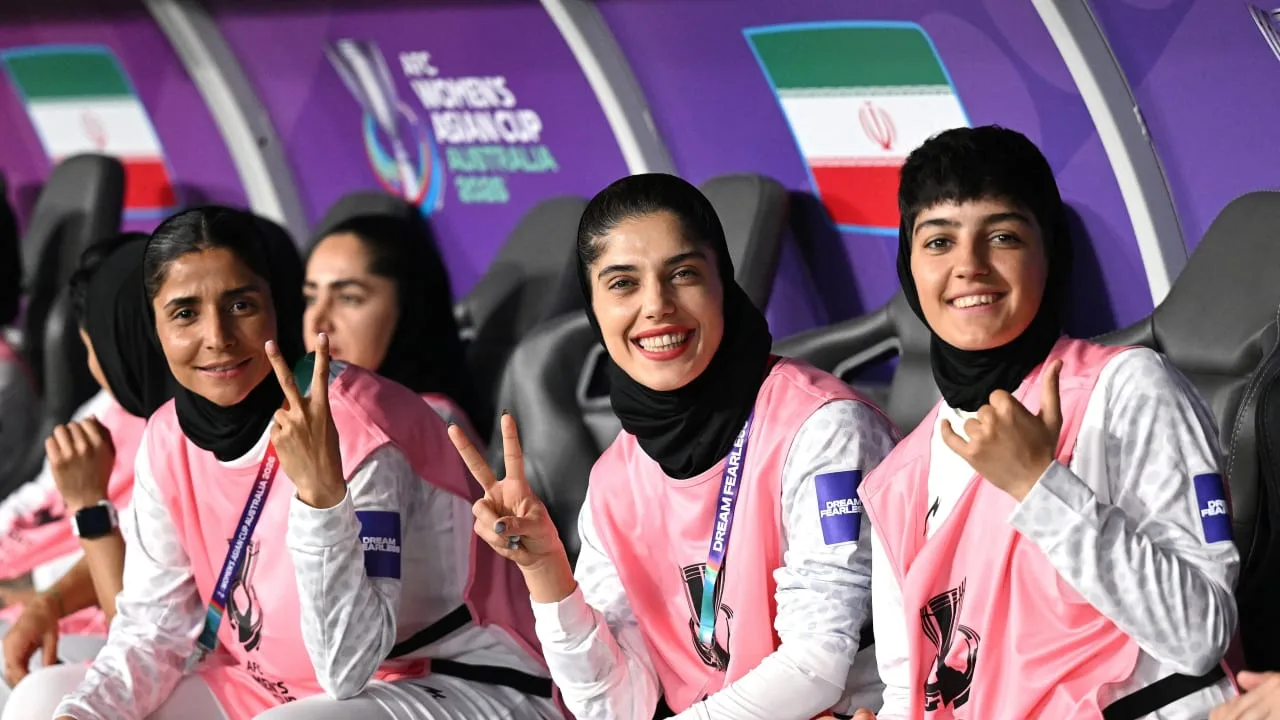
Australia has offered refuge to five members of Iran’s women’s national soccer team who faced threats of treason charges after refusing to sing their country’s anthem during an Asian Cup qualifier, with officials citing humanitarian concerns.
The players, including captain Zahra Ghanbari, Zahra Sarbali Alishah, Mona Hamoudi, Fatemeh Pasandideh, and Atefeh Ramezanizadeh, were granted visas by Home Affairs Minister Tony Burke using special ministerial powers.
They are now under police protection at a secret location.
Burke stated: “The other team members were also welcome to stay in Australia, noting that the initial five players wanted to stay.”
Immigration expert Simon Leske suggested the visas were likely subclass 449 temporary humanitarian ones, explaining: “It’s likely to be the subclass 449, humanitarian stay, temporary visa, which is a visa that can be used by the minister in very exceptional circumstances where there’s a need for a very quick grant to allow an individual to stay, and would then allow, subsequently, for the minister to grant a permanent visa.”
He added that Burke’s personal meeting with the players in Brisbane was unusual: “The fact that the minister actually traveled to Brisbane to meet with the players is quite an exceptional situation. I believe that’s probably due to the pressure within the community to show support.”
Prime Minister Anthony Albanese welcomed the decision, saying: “Australians have been moved by the plight of these brave women… They’re safe here, and they should feel at home here.”
Former Australian soccer captain Craig Foster noted family considerations: “Some may have concerns, others may not – but what we know is most of them have families back home, some of them have children back home, and even if offered the right to remain in Australia if they feel unsafe, many of them may not accept that opportunity.”
The protest occurred last Monday on the Gold Coast, where the team stood silent during the anthem before facing Thailand.
Iranian hardliners branded them “wartime traitors,” prompting the athletes to signal “Help” on camera after a loss to the Philippines.
Two more team members, a player and a staffer, opted to remain in Australia, while the rest returned home via Malaysia or Turkey after the UAE denied transit.
US President Donald Trump warned against deportation: “Australia would be ‘making a terrible humanitarian mistake’ to allow the women to be sent back.”
Israeli Minister Gila Gamliel urged protection: “There is a real threat to their freedom and even to their lives.”
Iran’s Vice President Mohammad Reza Aref rebuked foreign involvement: “No one has the right to interfere in the family affairs of the Iranian nation and play the role of a nanny who is kinder than a mother.”
Iran’s football federation called for a review of Trump’s comments as “direct political interference in football.”
The case echoes Australia’s 2021 asylum grant to Afghanistan’s women’s cricket team after the Taliban’s sports ban for women.
