



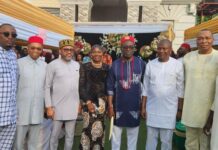

The Bishop of the Anglican Diocese of Amichi, Rt. Rev. Ephraim Ikeakor, has expressed concern over the decline of investigative journalism and urged media practitioners to return to thorough verification, factual reporting and professional integrity.
Bishop Ikeakor made the call in his keynote address at the grand finale of the 35th anniversary celebration of the Nigeria Union of Journalists (NUJ), Anambra State Council, and the NUJ Anambra State Man of the Year Awards.
He congratulated the NUJ Anambra State Council on attaining 35 years and challenged journalists to use the milestone as an opportunity for sober reflection, asking them to examine where the union came from, where it currently stood and where it wanted to go in the future.
According to him, the anniversary should not be limited to celebrating past achievements but should serve as a renewed commitment to truth, professional ethics, courage and service to society.
While tracing the historical origin of the concept of the media as the Fourth Estate of the Realm to Edmund Burke in 1771, the Bishop examined the responsibilities of journalists in contemporary society.
He described the theme of the celebration as timely and built his address around three major principles: reporting with truth, reporting with responsibility and reporting with service in mind.
Bishop Ikeakor warned journalists against sacrificing truth for personal comfort, financial benefits, political patronage or other interests, stressing that the credibility of journalism depends largely on the courage of practitioners to report what is right.
Citing John 8:32, he urged journalists to distinguish between facts and truth, noting that not every fact presented to the public necessarily amounts to the truth. He therefore challenged practitioners to develop the courage to establish the truth before publication.
The Anglican prelate identified junk or yellow journalism and investigative journalism as two broad approaches competing for space in today’s media environment. He expressed concern that sensationalism and poorly investigated reports appeared to be gaining ground, particularly in the digital era.
He consequently urged journalists to return to investigative journalism, describing the media as the watchdog of society and an essential instrument for sustaining democracy.
According to him, responsible journalism goes beyond simply publishing information, as journalists must verify their sources, investigate issues properly and provide adequate context to ensure that the truth is not distorted.
He also challenged journalists who could no longer tell the truth to reconsider their continued stay in the profession, warning that practitioners who deliberately sacrifice truth for brown envelopes or personal comfort undermine the foundation of journalism.
“Any journalist who sacrifices truth on the altar of comfort and brown envelope is deadlier than a terrorist,” he declared.
He stressed that the greatest tool of a journalist is not merely the pen but the “spine” and courage to stand by the truth.
On reporting with responsibility, Bishop Ikeakor said journalists must ensure that their reports are accurate, fair and independent.
He warned against rushing to publish unverified information simply to be the first to break a story, stressing that journalists must understand that they are responsible for the consequences of every piece of information they put into the public domain.
Describing responsibility as the backbone of journalism, the Bishop said both the report and the journalist behind it must be worthy of public trust.
He urged journalists to approach the profession as a service to the people rather than as an avenue for serving politicians, adding that practitioners should identify the information needs of the communities they serve and work to meet those needs.
The Bishop further emphasised the role of journalism in sustaining democracy, noting that the media serves as a critical check on power and provides citizens with the information they need to hold leaders accountable.
He expressed concern over the dependence of some media practitioners and organisations on government for their financial needs, arguing that excessive dependence could compromise media independence.
He therefore advised journalists and media organisations to develop sustainable sources of income, warning that a situation in which the government provides everything the media needs could make journalists submissive to those in power.
However, while advocating government support for the media through appropriate press and media subsidies, Bishop Ikeakor stressed that such interventions should strengthen rather than undermine media independence.
He maintained that, at 35 years of the NUJ in Anambra State, lack of funds and other challenges should no longer be accepted as excuses for poor professional performance.
For the financial sustainability of journalists and media organisations, he recommended diversification of income sources, leveraging individual and institutional strengths, maintaining high ethical standards and engaging audiences effectively.
The Bishop further identified three major tools that journalists and the NUJ should strengthen: robust and accurate coverage, reliable documentation and resilient information sharing.
He particularly advocated a functional and regularly updated NUJ Anambra State website capable of serving as a dependable database and source of information, as well as a platform for documenting critical issues of public concern.
Re-emphasising his call for Nigerian journalists to see themselves primarily as servants of the masses rather than servants of politicians, Bishop Ikeakor said the guiding principles of journalism should include holding the powerful accountable through watchdog and investigative reporting and giving voice to the voiceless.


