





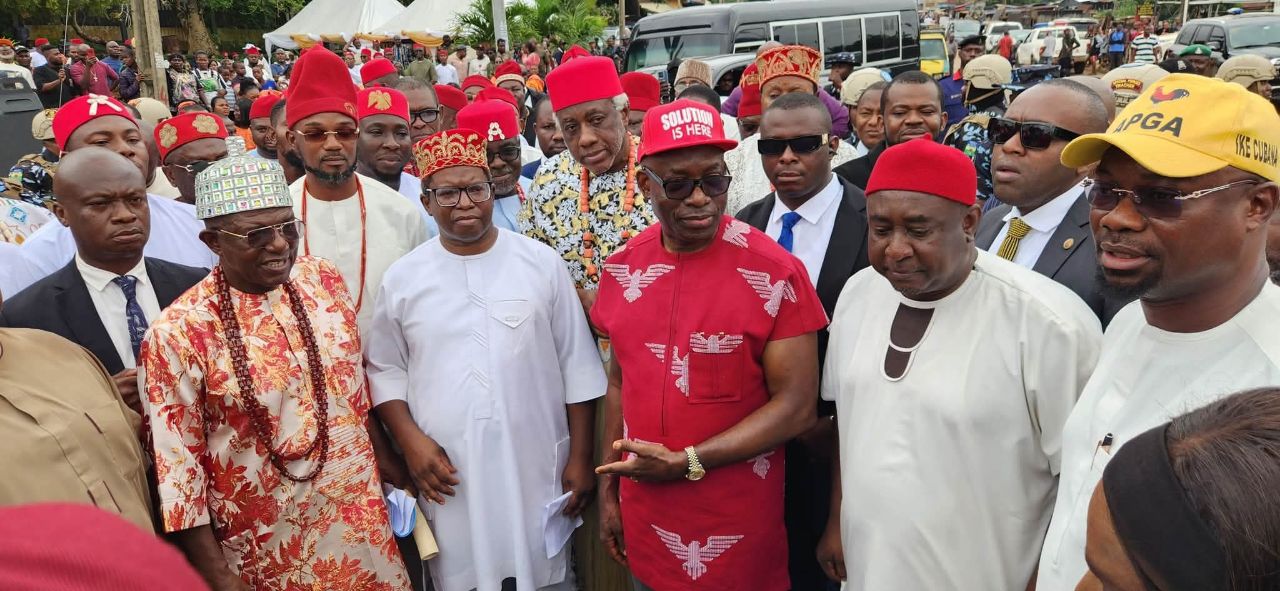
The solution governor of Anambra State, Professor Chukwuma Charles Soludo, CFR, says the future belongs to young people who choose purpose over violence and avarice. Recently, an opportunity offered itself again for Governor Soludo to show up as a leading moral agent.
The good people of the ancient kingdom of Ogidi in Anambra State decided to honour and immortalise their son, the legendary intellectual and foremost African writer, the late Professor Chinua Achebe, by erecting a statue of him. The solution governor of Anambra, Professor Chukwuma Soludo, unveiled the statue and used the opportunity to recall the life and times of the iconic writer, his place in history, the lessons to be drawn from his most exemplary life and the statue erected in his honour.
Achebe’s magnum opus, Things Fall Apart, from which the governor drew allusion, is renowned for its profound cultural wisdom, memorable proverbs, and critical exploration of the impact of colonialism on traditional Igbo society. The novel masterfully blends storytelling with thematic depth.
Governor Chukwuma Charles Soludo recounted how Chinua Achebe told the story of a typical Igbo man through this famous novel, Things Fall Apart. Soludo called out the aberration of a character named Uloka in Achebe’s novel, who, like many of today’s youths, thought that progress and happiness are attributable to supernatural means and not to hard work.
Yes, Uloka, the father of Okonkwo, the lead character in Things Fall Apart, visited the fortune teller to ascertain why his harvest was abysmally poor in a certain season. The diviner, unlike today’s fake prophets and native doctors, told Uloka that his poor yield was not caused by the gods but by his laziness and failure to act like other men who sought fertile lands in far-flung places while he tilled and planted on the same land year after year. “Go and be a man,” the oracle told Uloka, Soludo recounted.
Soludo used his analogy of the said Uloka in the story to draw a parallel between him and today’s youths who are being deceived by evil native doctors and fake pastors who produce charms for them. Charms like Okeite and Odeshi and fake prayers, which offer the youths Dutch courage and promises of wealth without work.
Saying, as always, that ‘Aka aja aja na-ebute onu mmanu mmanu’ (an Igbo idiom that roughly translates to ‘hard work yields progress and happiness’), Soludo emphasised that there is no shortcut to wealth and glory. Indeed Governor Soludo has established himself as a prominent moral agent in the state he leads, popularising this Igbo idiom and making it his refrain everywhere he goes.
He urged the youths of Ogidi and Idemili LGAs to emulate Chinua Achebe as a symbol of hard work and the virtues associated with the Igbo, or Onye Anambra. Soludo said Chinua Achebe would weep in his grave to see our youths embracing vices such as cultism, Okeite and many more negativities.
The governor had noted that Ogidi, the homeland of Chinua Achebe, along with Awka, Nkpor, Obosi, Umuoji, and Abatete, are hotspots for cult activities, and he urged their youths to change their ways and warned that there would be consequences.
Governor Soludo has turned attention more seriously to the issue of value reformation and has elevated it to a ministerial mandate, making it now the Ministry of Information and Value Reformation. The ministry has also taken up the challenge.
The Ministry of Information and Value Reformation, along with stakeholders, is developing a triad approach for value reformation in Anambra State, including both organisations and expert individuals.
The first leg of the triad approach is legislation, which is a process that will create the legal and governance framework necessary for value reformation in the state.
The second is ‘moral suasion’ – the use of rhetorical appeals, persuasion, or implicit pressure – rather than outright coercion or force – to change behaviour. It often appeals to common values, ethics or a “moral responsibility” to induce voluntary compliance.
Third, after moral suasion, enforcement will follow in cases of non-compliance. Certain actions that are criminalised by the Anambra Value Reformation Law will be strictly enforced, similar to the Anambra Homeland Security Law 2025, which contains specific provisions against Okeite and similar criminal practices. This enforcement has already resulted in the conviction and sentencing of Akwa Okuko Tiwara Aki and Onye Eze Jesus, while another individual, a fake Dibia named Eke-Hit, along with Muommiri-Afuluanya, is currently standing trial under the same law.
Anambra is therefore radically transforming, not just in terms of physical infrastructure and human capital development but also in moral and ethical rebirth for the emergence of a new Onye Anambra and an Anambra State that will be a destination of choice, where people can return to/visit, live, work, invest, relax and enjoy.

Yes, Anambra is rising under the very intentional and transformational leadership of the solution governor, Prof. Chukwuma Soludo.
· Dr Law Mefor is Commissioner for Information and Value Reformation, Anambra State.
