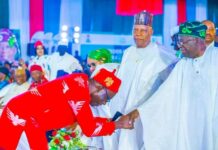


A coalition of Nigerian opposition parties is considering a proposal for a Government of National Competence limited to a single four-year term as part of efforts to present a united front in the 2027 general elections.
The framework was presented by Mallam Salihu Moh. Lukman on behalf of the G100 group at a summit of opposition parties held Monday at the Shehu Musa Yar’Adua Centre in Abuja.
Representatives from the African Democratic Congress (ADC), Allied Peoples Movement (APM), Nigeria Democratic Congress (NDC), Peoples Democratic Party (PDP), Peoples Redemption Party (PRP) and Social Democratic Party (SDP) attended, along with presidential and vice-presidential candidates and the Minority Leader of the House of Representatives.
Lukman said the proposed government would prioritise competence, integrity, national inclusion and fair representation of all participating parties, supported by a four-year National Reset Programme.
“The Framework before you propose something more demanding than a merger of ambitions: a Government of National Competence, built on competence, integrity, national inclusion, and fair representation of every party that contributes to the effort,” he said.
He stressed that any agreement must be enforceable rather than based on verbal commitments.
“We want to underline the word ‘enforceable.’ This gathering does not need more sincerity. Nigerian politics has never suffered from a shortage of sincere promises. What it has suffered from is promises that nobody could enforce when the person who made them changed his/her mind,” Lukman said, adding that any deal “must be written, it must be witnessed, and it must have consequences.”
He pointed to the fragmented opposition vote in the 2023 presidential election as a cautionary example, noting that combined opposition votes exceeded those of the eventual winner.
“Thirteen million votes on one side of the argument, under nine million on the other. And the side with fewer votes formed the government, lawfully, constitutionally, and entirely predictably,” he said.
The G100 proposed three standing bodies — a Central Leadership Committee, a Publicity and Communication Committee and a Legal Committee — along with five working groups tasked with producing proposals within four weeks on a National Covenant for Democratic Renewal, a Single-Term Transition Charter, a National Reform Programme, a Framework for Opposition Unity and a roadmap for selecting a common presidential candidate.
Lukman clarified that the summit was not calling for the dissolution of any party or the immediate withdrawal of candidates.
“It is not asking any party to dissolve. It is not asking any party to disappear into another party. It is not asking any candidate to stand down this morning… That question is not on the agenda of this Summit, and any report that says otherwise will be wrong,” he said.
He urged participants to state their positions openly, warning that hidden disagreements could later undermine the coalition.
The group said it was not endorsing any individual candidate or party but seeking a credible alternative government for Nigerians.
Working groups are expected to refine the proposals for consideration at a second summit.
