




Executive Director, Social and Integral Development Centre (SIDEC), Mrs. Ugochi Ehiahuruike have urged men to move beyond passive support and become active champions of gender equality in order to achieve meaningful social change.
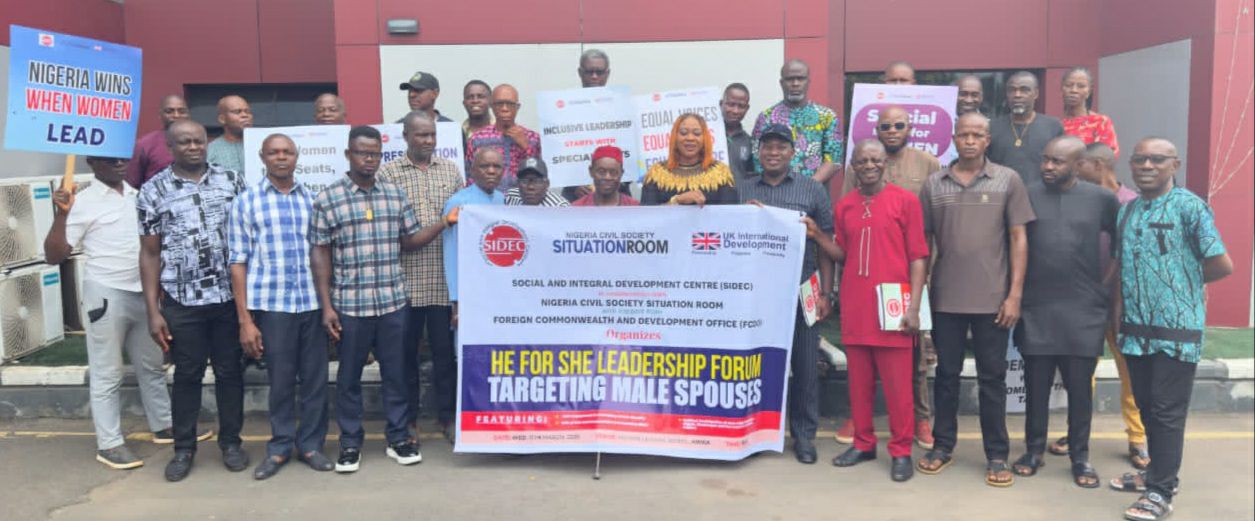
Ehiahuruike made the appeal at a He-for-She Leadership Forum organized for men under its Project IMPACT – Inclusive Mobilization for Participation, Advocacy, and Civic Transformation.
Angel Network News (ANN) reports that
the meeting which attracted politicians, the clergy, community leaders, civil society actors and the media examined the critical role of men in advancing gender justice and inclusive governance.
In her presentation titled “Understanding Men’s Engagement in Advancing Gender Equality,” SIDEC ED, Ehiahuruike, said men remain key actors in the pursuit of gender equity and must therefore become deliberate allies in addressing discrimination and harmful practices affecting women and girls.
She explained that although many men express support for gender equality, their level of commitment and action differs significantly.
According to her, men’s involvement in gender advocacy can be classified into five progressive stages, beginning with awareness and culminating in transformational engagement.
“The first stage involves awareness and understanding, where men seek knowledge about gender inequality and issues such as Sexual Exploitation, Abuse and Harassment (SEAH). At this stage, they recognise existing disparities but their engagement remains largely intellectual.
The second stage, she explained, is passive engagement, where men discuss gender issues and may condemn harmful practices but take little or no action to address them.
“The third stage involves active engagement, where men begin participating in programmes, campaigns and advocacy initiatives aimed at promoting gender equality and protecting women and girls from abuse and discrimination.
The fourth stage – leadership and allyship, she explained is where men emerge as visible advocates for gender justice, challenging discriminatory practices and supporting policies that expand women’s participation in governance.
“At the highest level is transformational engagement, where men demonstrate deep commitment to gender equality as a core value and actively work to influence cultural attitudes and dismantle entrenched gender norms,” she said.
Ehiahuruike, however regretted that a large number of men fall into the category of silent sympathisers. “These men believe in gender equality and agree that practices such as SEAH should end, but remain largely passive.”
She blamed the passivity of such men on entrenched socialisation patterns, fear of backlash and lack of clear understanding of how to act, warning that silence or inaction can inadvertently sustain gender inequality, limit meaningful allyship and reinforce harmful stereotypes.
“Another category of men are the occasional supporters. These are men who speak out against gender-based violence or injustice during high-profile incidents but whose engagement tends to be sporadic and crisis-driven. Their involvement often fades once public attention shifts away from the issue.
The SIDEC Executive Director argued that to achieve lasting change, gender advocacy must move men beyond sympathy to sustained action. “Providing clear pathways for engagement and expanding education on gender issues can help transform passive supporters into committed allies,” she concluded.
The forum also featured a presentation on inclusive politics by the Chairman of the Joint National Association of Persons with Disabilities (JONAPWD) in Anambra State, Ugochukwu Ernest Okeke.
Okeke emphasized that persons with disabilities have the same constitutional rights as other citizens to participate fully in Nigeria’s political processes.
He explained that since politics plays a critical role in determining leadership, resource allocation and policymaking, participation across strata of society is an essential component of democratic governance.
Okeke noted that the Discrimination Against Persons with Disabilities (Prohibition) Act guarantees persons with disabilities the right to vote, be voted for and participate in governance without discrimination.
“State disability laws including that of Anambra further reinforce these rights by promoting accessibility and equal participation in public life.
“Despite these legal provisions, men/persons with disabilities continue to face numerous barriers in the political space.
Okeke listed the challenges as: persistent societal stigma that questions the leadership capacity of PWDs, inaccessible public buildings and campaign venues, as well as financial constraints associated with political contests.
“Other challenges include: limited support from political parties and instances of discrimination during party primaries and elections.
To address these challenges, he called on governments and political institutions to take deliberate steps to promote inclusive politics.
He called on political parties to adopt policies that encourage the participation of persons with disabilities in leadership and candidate selection.
“There is need for leadership training, financial empowerment programmes and sustained public awareness campaigns challenging stereotypes surrounding disability.
He maintained that when persons with disabilities are fully included in political processes, democracy becomes stronger, more representative and equitable for all citizens.
Breakout session of the forum afforded participants the opportunity to brainstorm on factors limiting women participation in politics, solutions to the problems and strategies for tackling them.
Participants who underscored the importance of collective action in advancing gender equity, agreed that meaningful progress will require stronger partnerships among government institutions, civil society organizations and community leaders.
