





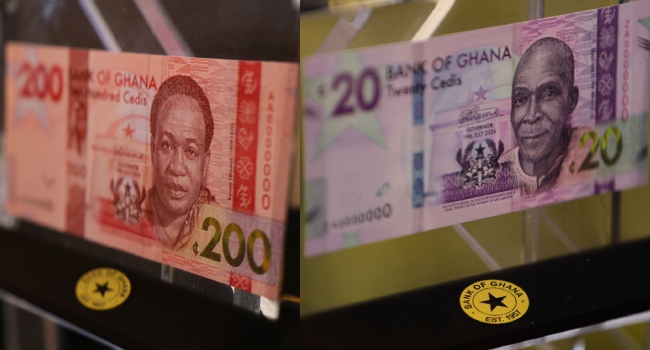
Ghana on Thursday unveiled a new series of smaller, more durable banknotes with upgraded anti-counterfeiting features and designs honouring national heritage, as the central bank modernises currency that has remained largely unchanged for more than two decades.
The “Heritage Series” is made from reinforced cotton paper, built to withstand heavy use and Ghana’s tropical climate and so reduce replacement costs. Improved tactile markings will help visually impaired users tell denominations apart, the Bank of Ghana said.
“The new notes are also smaller and easier to handle,” President John Mahama said at the launch ceremony in Accra, calling the changes practical improvements for everyday transactions.
Bank of Ghana Governor Johnson Asiama said the notes will enter circulation on December 1 alongside existing ones, which remain legal tender. The series keeps eight denominations from one to 200 cedis and restores the two-cedi note. It does not change the currency’s value or amount to a redenomination.
The designs feature Ghanaian figures including former UN Secretary-General Kofi Annan and independence leader Kwame Nkrumah, as well as historic landmarks.
The redesign comes as Ghana expands digital payments, though Asiama stressed the continuing importance of cash.
“Physical cash remains an essential pillar of our monetary resilience,” he said, warning that cyberattacks, technical failures or natural disasters could disrupt electronic systems.
The central bank is also preparing legislation to replace the 1964 Currency Act, with tougher penalties for counterfeiting and for deliberately destroying or misusing banknotes.
Cardinal Dery on GHC2 note
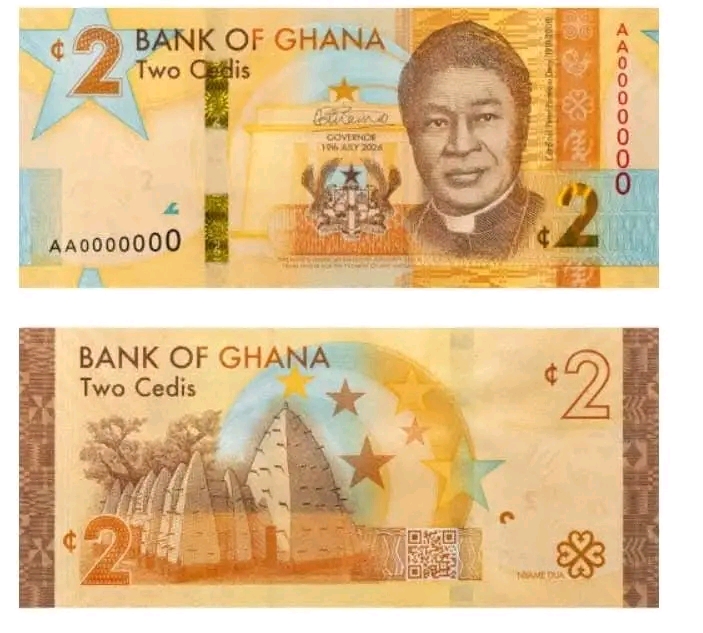
The Catholic Church in Ghana welcomed the decision to feature Cardinal Peter Poreku Dery on the GHC2 note. His family has also welcomed the honour, according to a commentary by JP Tindana.
Tindana said some people had objected that money bearing the prelate’s image could be used in undignified situations. He dismissed the concern, arguing that religious figures appear on banknotes elsewhere, and cited several countries have long placed saints, popes and church leaders on their currency. Vatican euro coins traditionally bear the effigy of the reigning pope, while older Vatican lira notes depicted popes and Catholic saints. Peru’s 200 nuevos soles banknote features Saint Rose of Lima, the first person born in the Americas to be canonised. Paraguay’s 100,000 guaraníes note honours Saint Roque González de Santa Cruz, a Jesuit missionary and martyr.
Armenia’s 50,000 dram banknote shows Saint Gregory the Illuminator, the country’s patron saint. Bulgaria’s 1 lev note carries the image of Saint Ivan of Rila, and Ukraine’s 1 hryvnia portrays Vladimir the Great, venerated as a saint for Christianising Kievan Rus’. Poland has issued a commemorative 50 złoty banknote honouring Pope John Paul II.
“Ghana has neither done anything strange nor committed any sin by having the image of Cardinal Dery on our banknote,” he said.
