





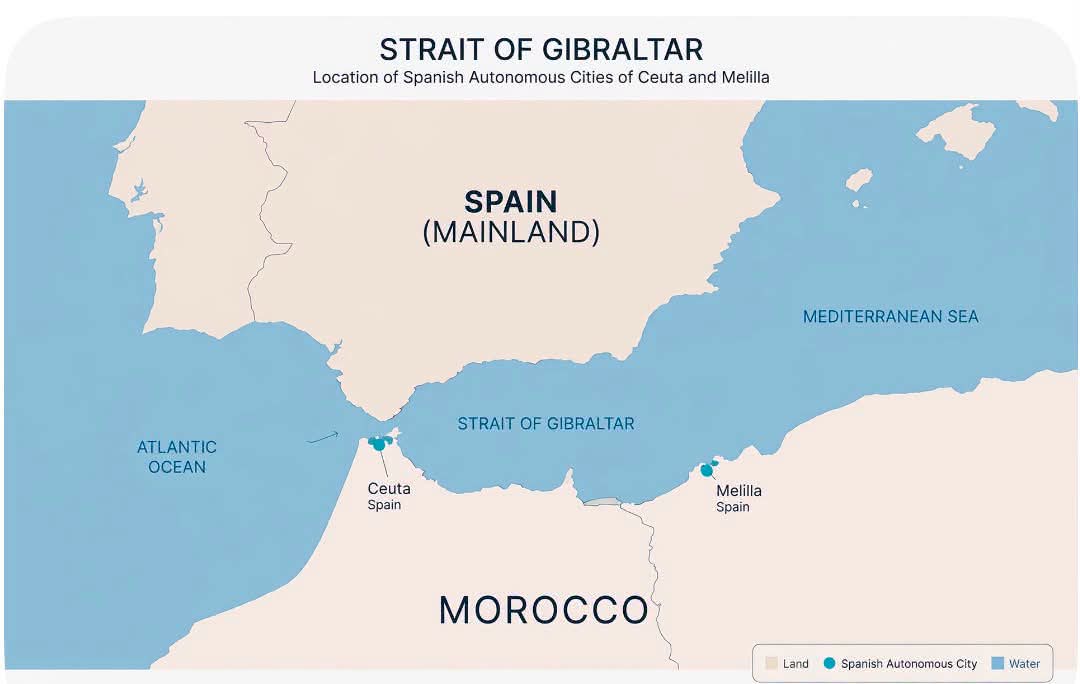
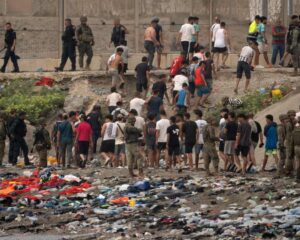
Thousands of Moroccan migrants entered Spanish territory last week without crossing the Mediterranean, by pushing into the North African enclaves of Ceuta and Melilla.
The two Spanish cities sit on the Moroccan coast and form the European Union’s only land borders on the African continent. More than 50,000 people surged into Ceuta in recent days, intensifying long-standing tensions between Madrid and Rabat.
Spain has controlled Ceuta since 1580 and Melilla since 1497. Morocco has rejected that sovereignty since independence in 1956 and continues to demand the return of the territories it calls Sebtah and Melilah.
“They are enclaves that have been occupied for centuries,” said historian Selim Balouati Lakhloufi.
Anthropologist Yolanda Aixelà Cabré noted that the holdings remain symbolically important for Spain. “Maintaining these enclaves is fundamental on a symbolic level because they reinforce Spanish grandeur, its imperial past,” she said.
Most of the recent arrivals have been returned to Morocco, though several thousand remain in Ceuta. Local resident Isabel, who described herself as half Christian and half Muslim, said the scale of the influx was “scary” even as many residents live side by side in relative harmony.
Around 84,000 people live in Ceuta and 86,000 in Melilla. Polling shows an overwhelming majority prefer to stay Spanish, citing higher social welfare standards than in Morocco, according to Lakhloufi.
Under international law, Morocco’s claim is considered weak and primarily political, Cambridge University fellow Jamie Trinidad said, comparing it to Spain’s own claim on British Gibraltar.
ANN Analysts remain divided on whether Spain will ever relinquish the enclaves, though most expect continued friction over border control and migration rather than a change in sovereignty.
