


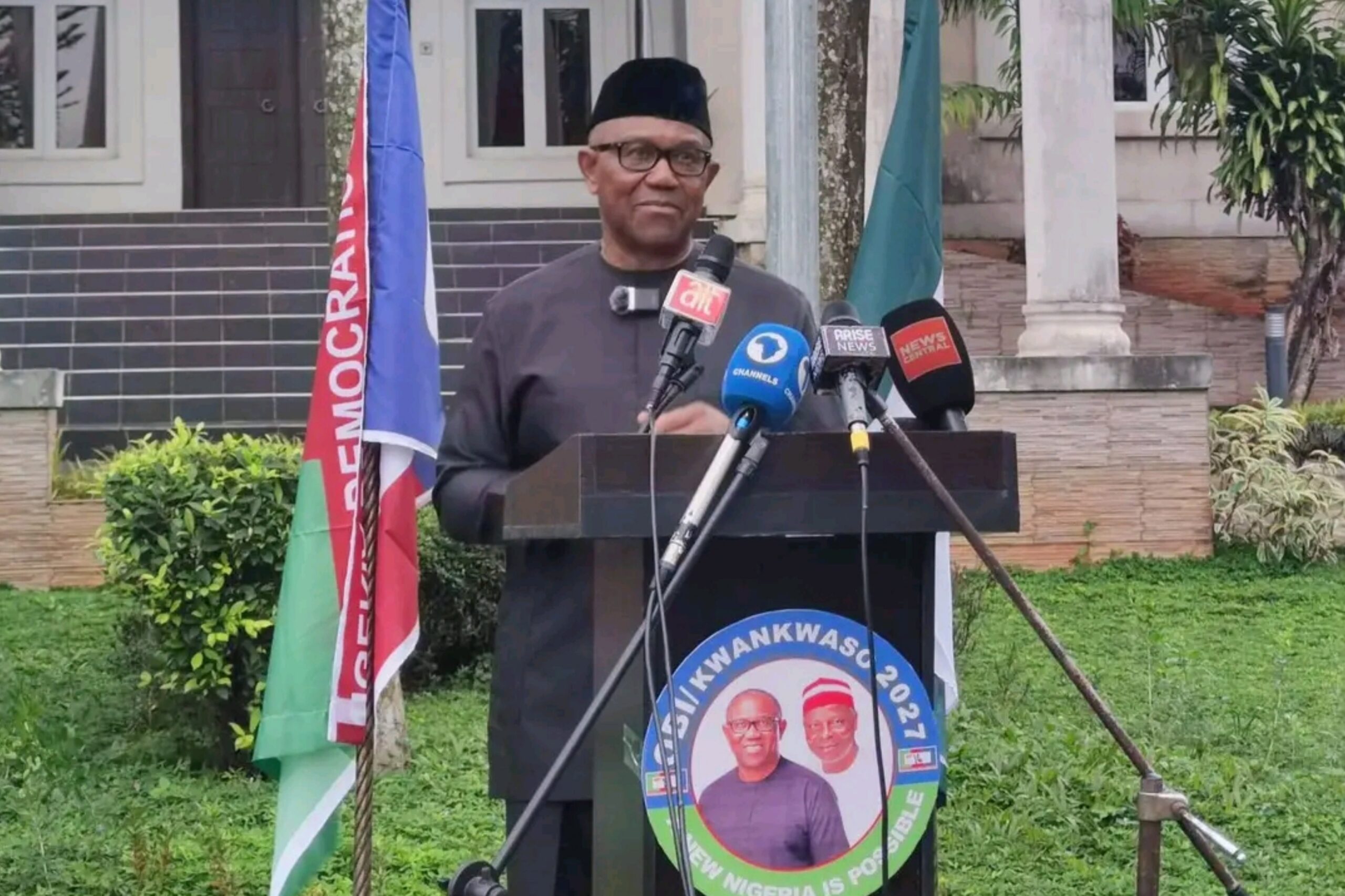
Former Anambra State governor Peter Obi on Friday formally opened his bid for the 2027 presidential election, declaring that Nigeria must move from a consumption-based economy to one centred on production, security and human capital.
In an address marking the official start of the campaign period for the presidential and National Assembly elections, which began on Wednesday, Obi said the contest offered Nigerians a chance to assess the records and plans of those seeking power at a time of “grave uncertainty.”
“I enter this contest with one firm conviction: Nigeria can work, and Nigeria must work,” he said.
Obi listed major challenges facing the country, citing IMF figures showing 63 percent of Nigerians, or more than 140 million people, living at or below the national poverty line. He noted that humanitarian agencies estimate 35 million people will need food assistance during the 2026 lean season, while about 3.6 million remain internally displaced by conflict and insecurity.
“These are more than statistics. They reflect the daily realities of Nigerian families, farmers, workers, students, and businesses,” he said.
He pointed to his private-sector background, policy studies and record as Anambra governor, alongside the complementary experience of his ally, Senator Rabiu Musa Kwankwaso, the former Kano governor. Both, he said, prioritised education, infrastructure and fiscal discipline.
“Public office is not a reward; it is a responsibility to the people,” Obi stated.
On the economy, he pledged to raise agricultural productivity through better security, irrigation, rural roads and market access, while strengthening manufacturing and agro-processing. He said public finances would be managed with clear priorities and measurable outcomes.
“The goal is not growth for its own sake, but an economy that produces more, employs more people, creates wealth, and improves living standards,” he said.
Security, he argued, remains the foundation of progress. He called for improved intelligence, stronger policing and border management, greater use of technology, and a carefully coordinated form of decentralised security management. He also stressed the need to address the conditions that draw young people into crime.
Obi rejected the notion that Nigeria’s large youth population is a burden, describing it instead as an opportunity if properly prepared through better education and technical training. He also promised to strengthen primary healthcare and improve maternal and child health outcomes.
He outlined region-specific strategies aimed at unlocking the economic strengths of the North-West, North-East, North-Central, South-West, South-East, South-South and the Federal Capital Territory, insisting that “every region must produce, every region must contribute, every region must benefit.”
Obi urged an issue-based campaign free of ethnicity, religion or propaganda and committed to campaigning personally rather than through proxies.
“My running mate and I will take our message directly to Nigerians. We will listen to them, understand their concerns, and engage them openly. We will not delegate this duty to proxies,” he said.
“Any presidential candidate who lacks the resolve to travel across the country, meet the people, and respond to their questions lacks the capacity to govern it.”
He closed by pledging to unite the country, restore security and place it on a path of inclusive growth. “A New Nigeria is possible,” he said.
