





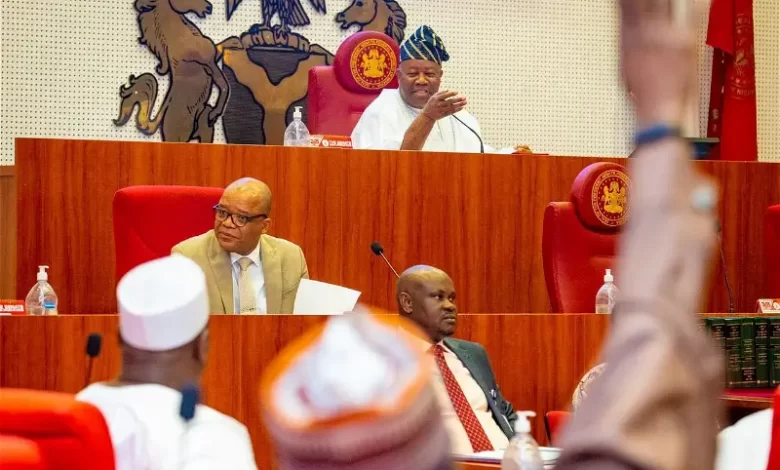
Senators on Thursday charged Senate President Godswill Akpabio with altering official records to excise electronic transmission of election results from a newly passed electoral bill, insisting the chamber had endorsed the measure during deliberations.
The allegations surfaced a day after the Senate approved amendments to the 2022 Electoral Act, rejecting mandatory digital relays of vote tallies and upholding manual processes that critics argue leave room for manipulation.
Led by former Senate Minority Leader Enyinnaya Abaribe, ex-governor Aminu Tambuwal and Natasha Akpoti, the lawmakers convened a press briefing in Abuja to decry what they termed a forgery aimed at undermining transparency.
“To put the records straight, the Senate did not pass the transfer of results which was in the 2022 Act. What we passed; and which the Senate President himself, when he was doing a clarification, sitting on his chair; is transmission of results,” Abaribe said.
He added: “I can assure you on my honour and on the honour of all of us here, that both the electoral committee of the Senate and the ad-hoc committee of the Senate; and also in the executive session that we had, that we all agreed on Section 60(3) which is electronic transmission of results. Transmit, not transfer. What is in the 2022 act is transfer, and we don’t want a law that is vague or can be misinterpreted. We want a law that is clear, concise, and can be interpreted by all and that is unambiguous, so, it is electronic transmission of results.”
The disputed bill retains provisions for physical voter cards and manual result collation, dashing hopes for compulsory electronic uploads that proponents say could curb fraud in Africa’s most populous nation.
No immediate response came from Akpabio’s office, but the claims have fueled debates on electoral integrity ahead of 2027 polls, where digital reforms remain a flashpoint following controversies in the 2023 vote.
