





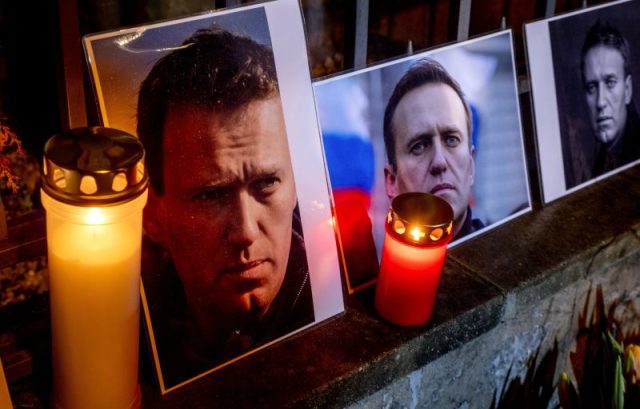
Britain and several European partners accused Russia Thursday of assassinating jailed opposition figure Alexei Navalny in 2024 using a potent neurotoxin sourced from Ecuadorian dart frogs, vowing to escalate pressure on Moscow by submitting forensic evidence to the global chemical weapons watchdog.
The revelations emerged at a press conference during the Munich Security Conference, where Navalny’s widow Yulia Navalnaya, joined by foreign ministers from Britain, Germany, Sweden and the Netherlands, detailed findings from an international probe.
Navalnaya, addressing the gathering in English, recounted the ordeal: “It was the most horrible day in my life. I came to the stage and I said my husband, Alexei Navalny, was poisoned. What could else happen with Putin’s number one enemy in a Russian prison? But now I understand and I know it is not just words. It is scientific proof.”
The toxin, identified as epibatidine — 200 times more powerful than morphine — was confirmed in Navalny’s body through collaborative efforts by the UK, Sweden and others.
British Foreign Secretary Yvette Cooper stated: “As a result of the work of the UK, Sweden and other partners, we have confirmed that a deadly toxin was found in Alexei Navalny’s body. And that toxin has been identified as a toxin that is found in Ecuadorian Dart Frogs.”
She added: “Only the Russian government had the means, the motive and the opportunity to use that toxin against Alexei Navalny in prison and that is why we are here today to shine a spotlight on the Kremlin’s barbaric attempt to silence Alexei Navalny’s voice. To show that the Russian government has contempt for its citizens and the willingness to use this deadly toxin.”
Cooper invoked Navalny’s words: “He said: ‘We must do what they fear, tell the truth, spread the truth that is the most powerful weapon’.”
German Foreign Minister Johann Wadephul described epibatidine’s horrific impact: “Its effects are particularly strong and that victims suffocate in agony.”
Sweden’s Maria Malmer Stenergard emphasized accountability: “This is extremely important in order to be able to hold Russia accountable for what they have been doing and to continue to shine a light on their continuous lies. We will now move forward with this information to the OPCW… This is yet another way to increase the pressure on Russia.”
Navalny, a fierce Kremlin critic, died on February 16, 2024, while serving a 19-year term in a remote Siberian penal colony. Russian officials attributed his death to “combined diseases,” including cardiac issues, but the new claims challenge that narrative.
He was interred outside Moscow the following month. The activist had previously survived a 2020 Novichok nerve agent attack, recovering in Germany before returning to Russia and facing arrest.
The allies intend to present their dossier to the Organisation for the Prohibition of Chemical Weapons, though the method of toxin delivery remains unclear — traditionally, indigenous South American tribes apply it to blow darts for hunting.dba4ec The Kremlin has yet to respond to the allegations.
