




The Nigeria Security and Civil Defence Corps, Anambra State Command, has urged students of Chukwuemeka Odumegwu Ojukwu University, COOU, Igbariam, to adopt a safety-first mindset and play active roles as first responders during emergencies.
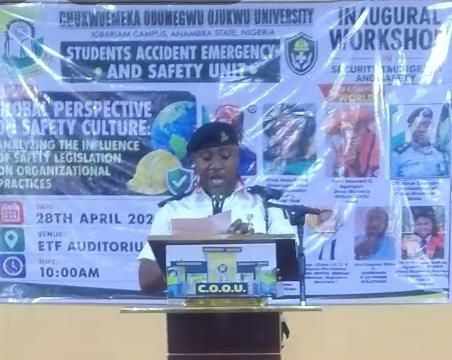
The call was made on Tuesday, 28th April, 2026, during a public enlightenment lecture delivered by Superintendent of Corps Okadigbo Edwin, the Command’s Spokesperson on behalf of the State Commandant, Commandant Maku Olatunde.
Angel Network News (ANN) reports that
the lecture was held at the Igbariam campus during the inaugural workshop of the Students’ Accident, Emergency and Safety Unit.
Delivering the lecture titled, “Understanding Types of Emergencies: Preparedness, Response, and the Role of Citizens,” Okadigbo stressed that emergencies occur without warning and the first response often determines the outcome.
“Emergencies do not send invitations. They happen in hostels, lecture halls, markets, and on our roads. When they do, your first response can be the difference between life and death,” he said.
He defined an emergency as any sudden, unexpected situation that poses an immediate threat to life, property, health, or the environment and requires urgent action.
Okadigbo identified the key characteristics of emergencies as suddenness, threat, and urgency , noting that normal procedures cannot handle them.
Common campus emergencies highlighted include fire outbreaks from electrical faults, medical incidents such as stampedes and food poisoning, security threats like cult clashes and kidnapping attempts, natural disasters, infrastructure failures, and public health crises.
The lecture outlined the four-phase Emergency Management Cycle adopted by the NSCDC: Mitigation/Prevention, Preparedness, Response,and Recovery. Students were advised to focus on mitigation, preparedness, and early response, while leaving high-risk operations to trained responders.
Okadigbo also detailed the Corps’ mandate under the NSCDC Act 2003, as amended 2007, which includes disaster management, protection of Critical National Assets and Infrastructure, crisis management, public enlightenment, and regulation of private guard companies. He noted that the NSCDC works in collaboration with the Fire Service, Nigeria Police Force, SEMA, NEMA, and the Red Cross.
Students were taught the S.A.F.E principle, Stop, Assess, Find help, Evacuate/Execute as an alternative to panic during emergencies. Practical steps were shared for fire outbreaks, security threats, and medical emergencies, including how to raise the alarm, evacuate safely, report incidents, and apply basic first aid if trained.
Okadigbo charged students to take personal responsibility for safety by knowing their environment, saving emergency numbers, volunteering with safety groups, reporting suspicious activities, and avoiding the spread of false alarms.
“Emergencies test systems, but they reveal people. Nigeria needs students who are not just certificate holders, but safety-conscious citizens. You are our first responder in your hostel, your department, your faculty,” Okadigbo stated.
He reaffirmed the commitment of the NSCDC Anambra State Command, under Commandant Maku Olatunde, to the protection of lives, property, and Critical National Assets, and called for collective efforts to build a safety culture.
“Let us build a safety culture together, because the best emergency is the one that never happens,” he concluded.
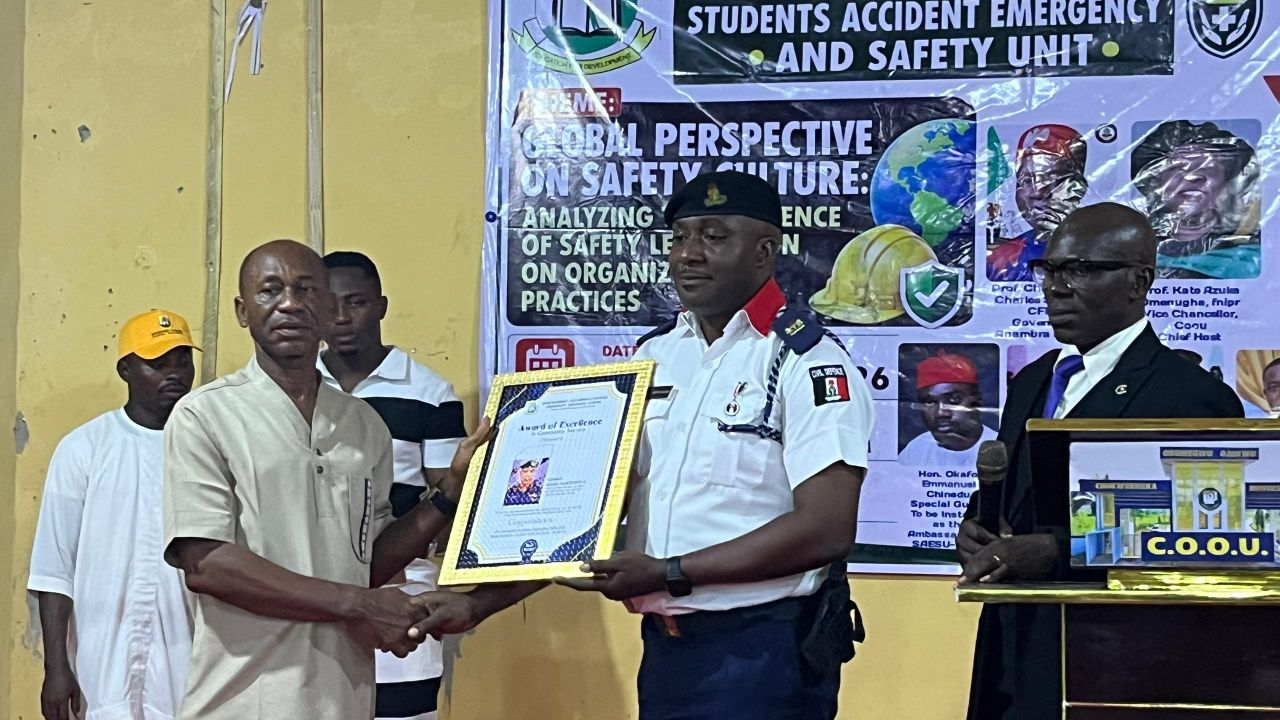
The highlight of the workshop was the presentation of the University Award for Community Service to the State Commandant, Commandant Maku Olatunde.