





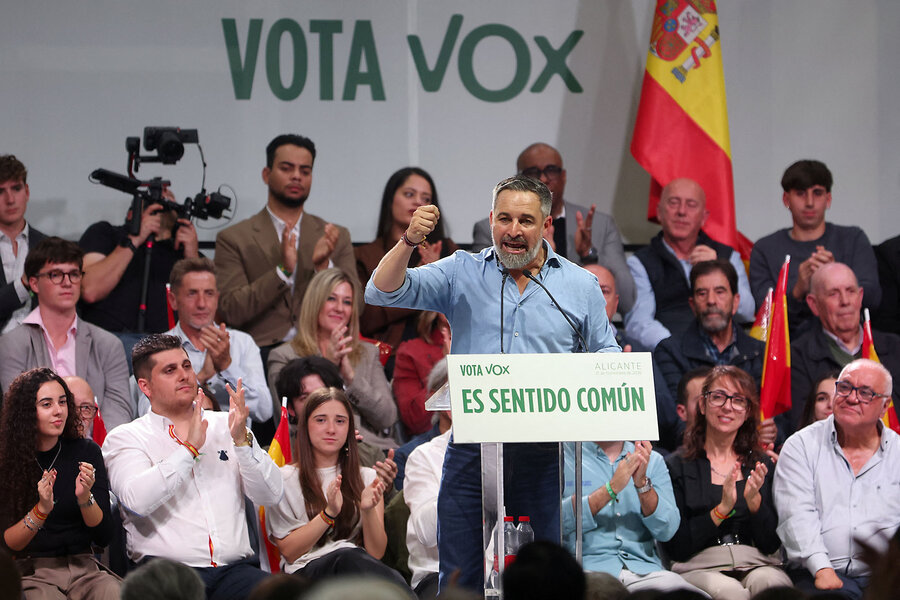
Spain’s Vox party is winning a growing share of young voters, particularly men, ahead of Sunday’s snap election, drawing on economic pressure and anti-immigration messaging that could help carry it into national government for the first time since the end of the Franco dictatorship.
Ahead of the Socialists among 18-24s
Data from the Spanish Centre for Sociological Research shows 23.2 per cent of voters aged 18 to 24 intend to back Vox, narrowly ahead of Prime Minister Pedro Sánchez’s Socialists (PSOE) on 22 per cent. Vox’s support in that age group was 15.4 per cent in the 2023 election. Among 25 to 34-year-olds, it has risen from 15 per cent to around 22 per cent.
The centre-right People’s Party (PP) leads overall polls on about 31.5 per cent and has not ruled out a coalition with Vox. Such a deal would mark a historic shift, as the far right has stayed out of national government since 1975.
“The most logical choice”
Andres, a 19-year-old first-time voter and student in Madrid, told Infobae that Vox leader Santiago Abascal “is undoubtedly the most logical choice.” He describes himself as Catholic, backs traditional family values and opposes what he calls “LGBT+ ideology”.
Political scientist Maria Elisa Alonso of the Université de Lorraine said this generation faces heavy economic pressure and has no direct memory of dictatorship. “They are drawn to the narrative that blames immigrants for all the country’s problems,” she said.
Housing squeeze
Young Spaniards leave the family home at around 30 on average, against an EU average of about 26, according to Eurostat. An average 50-square-metre apartment in Madrid can cost around €1,170 a month in rent, close to half the national average gross salary of €2,460.
Vox has pledged land deregulation, tax cuts and action against illegal squatting. At rallies, Abascal has focused on immigration, saying some people live “off the social benefits that Spaniards need and who have no business being in Spain.” He has called for “rapists” and “murderers” to be held “in prisons in their own countries” and for a “remigration” policy to “reverse the migrant invasion.”
“Vox’s message is very simple,” Alonso said. “There isn’t really a political platform. Everything is the fault of immigration. They conflate immigration with crime. It’s a narrative that resonates with these disillusioned young people.”
Social media and a gender gap
Short videos on patriotism, national identity, traditional family values and critiques of feminism have helped Vox reach younger audiences on TikTok, Instagram and X.
Roughly a quarter of male voters under 35 lean towards Vox, compared with about 20 per cent of women in the same age group, according to a 40dB survey for Cadena SER. Young women show higher support for the Socialists.
Vox has signalled plans to roll back parts of Spain’s gender-based violence protections and its self-determination rules on gender identity. Alonso said some young men “see women as a threat to them and want to return to Spanish society as it was fifty years ago.”
Young Spaniards on the streets
Not all young people share this outlook. Housing protests that began in late September have drawn large crowds, including many young people, demanding action on rents, wages and public services. A general strike took place on November 11.
Alonso saw a split. Some prioritise better living conditions through street action, while others, particularly young men, focus on national identity and want a change of government. “They want to bring down the government and see Vox come to power,” she said.
Spaniards vote on November 29.
