





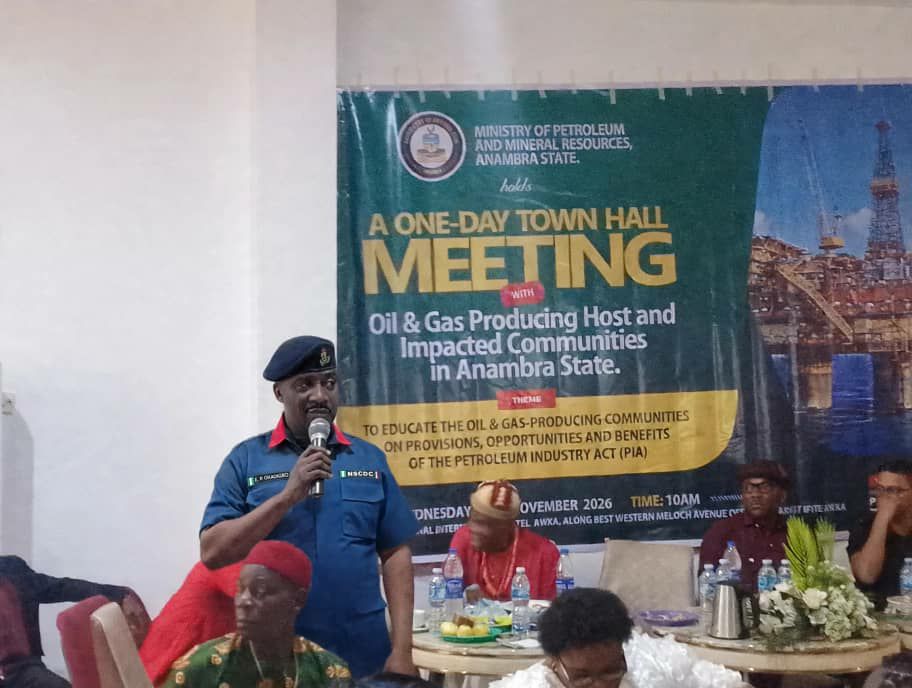
The Nigeria Security and Civil Defence Corps (NSCDC), Anambra State Command, has urged host and impacted communities in the state to take ownership of the protection of petroleum infrastructure within their domains.
The Corps warned that pipeline vandalism is not merely a crime against oil companies but also an offence against the communities themselves, as it leads to environmental pollution, destruction of livelihoods, loss of lives and economic setbacks.
The call was made on Wednesday, November 25, 2026, during a one-day town hall meeting on the Context and Content of the Petroleum Industry Act (PIA) and the Place of Host and Impacted Communities in Anambra State, organised by the state Ministry of Petroleum and Mineral Resources.
Delivering a paper titled, “The Role of the Nigeria Security and Civil Defence Corps (NSCDC) in Protecting Oil and Gas Facilities, Preventing Pipeline Vandalism and Promoting Community Participation in Security in Anambra State,” the State Commandant, Commandant Maku Olatunde, represented by the Head of Media and Tactical Operations, Chief Superintendent of Corps (CSC) Okadigbo Edwin, urged host communities to partner with the Corps in safeguarding critical national assets and infrastructure.
In his presentation, CSC Okadigbo explained that pipeline vandalism destroys farms, pollutes water sources, claims lives, deprives government of revenue and disrupts peace in affected communities. He stressed that protecting petroleum infrastructure was therefore a collective national responsibility.
He traced the legal mandate of the Corps to the NSCDC Act No. 2 of 2003, as amended by the NSCDC (Amendment) Act No. 6 of 2007, particularly Section 3(1)(f), (g) and (h), which empowers the Corps to arrest, investigate and prosecute persons involved in the vandalism of pipelines and other critical national assets, maintain 24-hour surveillance over infrastructure and prevent terrorism and sabotage of oil pipelines.
He added that the Petroleum Production and Distribution (Anti-Sabotage) Act and the Miscellaneous Offences Act also criminalise pipeline vandalism and illegal bunkering as acts of economic sabotage against the country.
Speaking on the Corps’ operational strategies, Okadigbo said the NSCDC provides static and mobile security personnel at flow stations, depots, tank farms and gas plants, conducts day and night patrols along pipeline routes and creeks, dismantles illegal refineries and collaborates with NEMA, SEMA and the Fire Service during oil spills and other emergencies.
He identified greed and criminal networks, poverty and unemployment, perceived exclusion of host communities, weak intelligence gathering and poor reporting culture as some of the major factors contributing to pipeline vandalism, noting that effective prevention requires more than the use of force.
The CSC emphasised community-based security awareness, prompt reporting of suspicious activities and active community participation as essential measures for achieving lasting protection of petroleum infrastructure.
He urged residents to embrace the “See Something, Say Something” culture by reporting suspicious vehicles, unfamiliar persons digging or welding near pipelines at night, unusual smells of crude oil, bush burning around pipeline routes and the movement of large quantities of jerrycans and drums.
Such information, he said, should be reported to the nearest NSCDC office, traditional rulers, town union leaders or through the Corps’ emergency lines, assuring residents that the identities of informants would be treated confidentially.
He further explained that the NSCDC promotes community participation by building trust through regular engagements and open dialogue, involving town unions and vigilante groups in security planning, training and supervising local vigilantes and neighbourhood watch groups, recognising communities that report criminal activities and mediating early in disputes between host communities and oil operators.
He added that the Corps also advocates development, employment opportunities and inclusion for host communities as part of efforts to address grievances that could encourage criminal activities.
On inter-agency collaboration, Okadigbo maintained that no single security agency could effectively protect petroleum infrastructure alone. He said the NSCDC works with the Army, Police, Department of State Services (DSS), Navy and Immigration Service through joint patrols and intelligence sharing.
He also highlighted its collaboration with government agencies on policy support and prosecution, oil and gas operators on joint surveillance and rapid response, and host communities through traditional rulers, town unions and youth leaders.
Among the challenges confronting the protection of petroleum infrastructure, he listed difficult riverine terrain, inadequate vehicles and surveillance equipment, fear of reprisal among informants, poor reporting culture, alleged collusion by some insiders and limited manpower.
To address these challenges, he recommended stronger intelligence-led patrols, deeper partnerships with traditional rulers and town unions, protection of informants, regular town hall meetings and deliberate efforts to ensure that host communities benefit from development projects around oil facilities.
Concluding his presentation, CSC Okadigbo declared: “The pipeline does not belong to NSCDC alone, and it does not belong to the oil company alone. It belongs to all of us. If it is vandalised, we all lose. If it is protected, we all gain.”
The town hall meeting attracted stakeholders from government, oil and gas operators, traditional institutions, town unions, youth and women groups, as well as host and impacted communities across Anambra State.
