





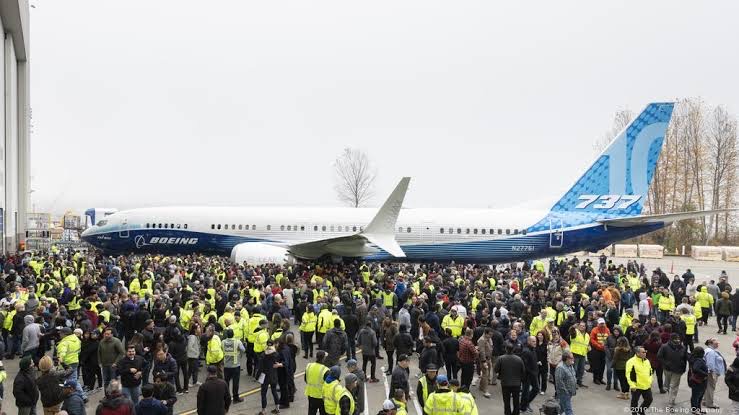
While company leaders publicly express confidence in the coming 737 MAX 10 and MAX 7, the Boeing Co. has also signaled a worst-case scenario for investors.
Boeing (NYSE: BA) now expects certification work on both aircraft — the largest and smallest members of the MAX family next year — to likely stretch into next year, meaning both each could miss a mandated year-end deadline on new cockpit requirements that, barring an extension from Congress, could trigger costly rework on the aircraft.
In the manufacturer’s third-quarter 10-Q filingwith the Securities and Exchange Commission, the company cautions that if the “deadline is not amended and we otherwise fail to achieve certification, we might choose to discontinue the MAX 7 and/or MAX 10, resulting in future earnings charges and other financial impacts.”
The filing adds that some of those potential costs might be offset by customers switching orders to its existing MAX 8 and MAX 9 aircraft.
While Boeing CEO David Calhoun raised the specter of possibly cancelling the MAX 10 program in July, the company’s 10-Q for the second quarter cautioned only that future earnings/sales could be “adversely impacted” by a slip in its expected certification timeline at the time.
Boeing said at the end of the third quarter that it had orders for around 600 MAX 10s and around 250 MAX 7s in its firm backlog.
While holding out hope that the MAX 7 could still achieve certification before the end of the 2022, the company has conceded MAX 10 work won’t be completed until sometime next year and that its entry into service could slip even into 2024.
Spirit AeroSystems Inc. in Wichita builds around 70% of the structure on the MAX in Wichita, part of a 737 program that has historically accounted for half of the local supplier’s annual sales.
While the MAX 10 and MAX 7 comprise only around 20% of Boeing’s total MAX backlog, the end of either or both programs would negatively impact future production work at Spirit (NYSE: SPR), which remains the city’s largest employer with around 11,000 local workers.
Stacking up to Airbus
The deadline in question involves installation of a new engine-indicating and crew-alerting system (EICAS) in all aircraft certified after 2022.
That was mandated by the Aircraft Certification, Safety and Accountability Act passed by Congress in 2020 in the wake of two crashes of MAX 8 aircraft in late 2018 and early 2019 that killed all 346 people aboard.
The previously certified MAX 8 and MAX 9 models began returning to service from a 20-month safety grounding in November 2020.
The two-year grace period included in the 2020 legislation had originally been expected to give Boeing time to get the MAX 10 and MAX 7 to the market before the deadline.
While Boeing’s filing laid regulatory groundwork for a potential termination, Calhoun expressed confidence in a needed certification extension in the company’s quarterly earnings call with investment analysts and reiterated the company’s belief that fewer changes would actually increase the safety of the aircraft by maintaining commonality for pilots.
We remain confident that we can get an extension of that deadline, because this is the safe answer, and we’ve heard from airlines, we’ve heard from pilots, we’ve heard from our workers, associates, and we know that the FAA has been putting in the work to certify these airplanes,” the CEO said on the Oct. 26 call. “So we remain not just hopeful but confident that we can get this across the finish line. And then those airplanes … complete that narrow-body portfolio in a way that allows us to compete head-to-head with our important competitor, Airbus.”

But an examination of Boeing’s current strategy written by veteran aviation analyst Scott Hamilton for Leeham News — a report that also notes Boeing’s hint in Q3 at potentially ending the programs — speculates that the company is already too far behind its European rival for the new MAXes to move the needle on market share.
Hamilton says Airbus’ A321neo is already outselling the MAX 10 by around 5 to 1 and its A220-300 is outpacing the MAX 7 by around 2.5 to 1 on sales.
He says the message from Boeing leaders during its recent investor conference was that the “value proposition” of the MAX jets would eventually sway the market.
But, the analyst concluded, the truth of the market-share battle already lies in the dried ink on orders.
“The ‘value proposition’ is a Boeing message that is now decades old. It’s out of date,” Hamilton says. “Frankly, the customers — airlines and lessors — voted with their checkbooks long ago whether they see a better value proposition from Boeing or Airbus aircraft.”
Spirit also has work on both Airbus aircraft, though it is significantly smaller in scope than its work on the MAX and is done at factories outside of Wichita.
