



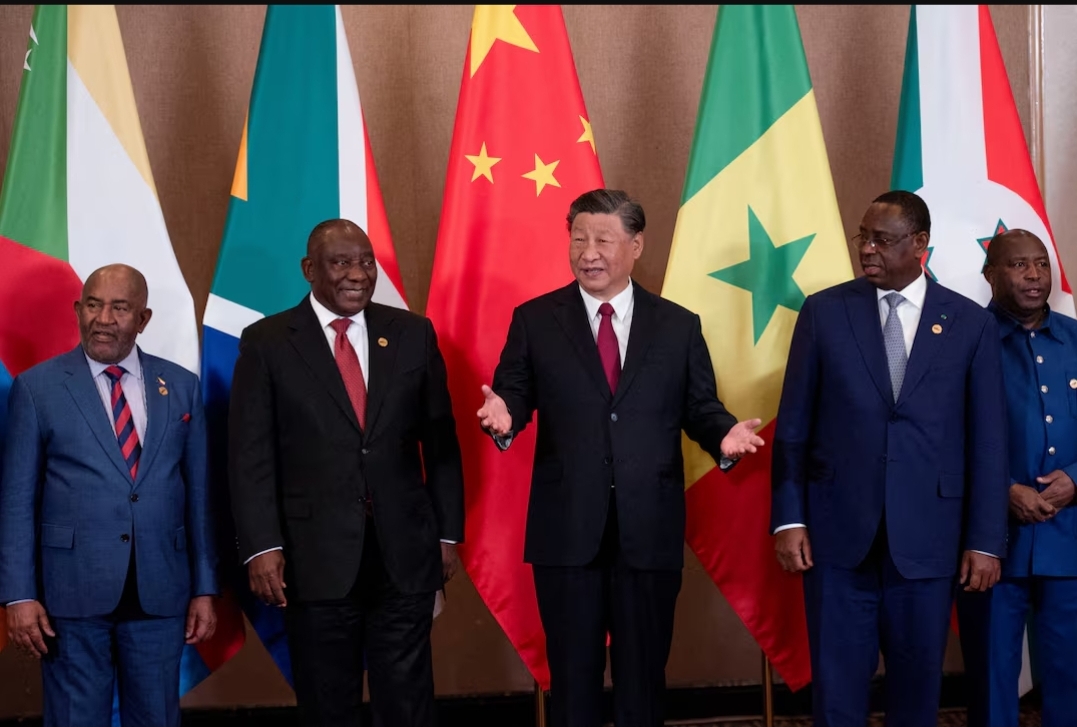
Leaders of the expanded BRICS grouping of emerging economies gather in the Indian capital this weekend for a summit that will test the bloc’s ability to present a united front and advance a more multipolar world order.
India hosts the two-day meeting starting Saturday, with Russian President Vladimir Putin arriving in New Delhi on Friday. The summit comes more than six months after the United States and Israel launched military action against Iran, a BRICS member since 2024, exposing deep divisions within the group that also includes the United Arab Emirates.
The alliance — comprising Brazil, Russia, India, China, South Africa, Iran, the UAE, Saudi Arabia, Egypt, Ethiopia and Indonesia — was formed to give greater voice to the Global South and reduce reliance on Western-led institutions. As it nears its 20th anniversary, analysts say BRICS has contributed to a more multipolar landscape but has fallen short of building a coherent alternative to the West.
“We tend to undermine any BRICS-led initiative as it is not the revolution we have expected,” Brazilian researchers Octavio Oliveira and Enzo Godinho of the University of Sao Paulo’s BRICS Studies Group told Al Jazeera. “Yes, it does not have the institutionality or the capacity of the UN to tackle specific geopolitical issues, but its mere existence is a much more important platform for Global South countries to express their voices and bypass the West in cooperation.”
Sean Burges, an associate professor of international studies at Carleton University in Canada, said the bloc’s main shared goals remain practical. “The two priorities uniting the BRICS countries are largely a desire to make lots of money through international trade and to see an end to the preachiness of the ‘West’ about where they are failing in terms of rights and democracy,” he said.
Despite accounting for nearly half the world’s population, around 40 percent of global output in purchasing-power terms and significant oil production, the group’s collective leverage remains limited. Its New Development Bank has approved about $39 billion in projects by the end of 2024 — a fraction of World Bank lending — and continues to raise most funds in US dollars.
“Despite extensive rhetoric about de-dollarisation initiatives, the vast majority of BRICS trade is still denominated in US dollars,” Oliveira and Godinho noted, highlighting the structural dependency that constrains policy independence.
Imran Khalid, a geostrategic analyst, described BRICS as “a platform for autonomy rather than a challenger to the Western-led order.” Without a common currency, tariff regime or defence commitments, it is not a conventional geopolitical bloc, he said, yet it has given Global South countries more room to manoeuvre and made it harder for the West to apply pressure on individual members.
Internal differences were on display in May, when foreign ministers meeting in India failed to issue a joint statement on the Iran conflict because of disagreement between Tehran and Abu Dhabi. Analysts say the expansion of membership has broadened representation while making consensus even more difficult.
Guy Burton, a geopolitical analyst, observed that members deliberately preserve their freedom of action. “There’s no ‘one for all, all for one’ logic in BRICS,” he said.
The New Delhi summit will therefore focus less on overturning the existing order and more on practical cooperation and amplifying the Global South’s influence within a shifting international system.
