





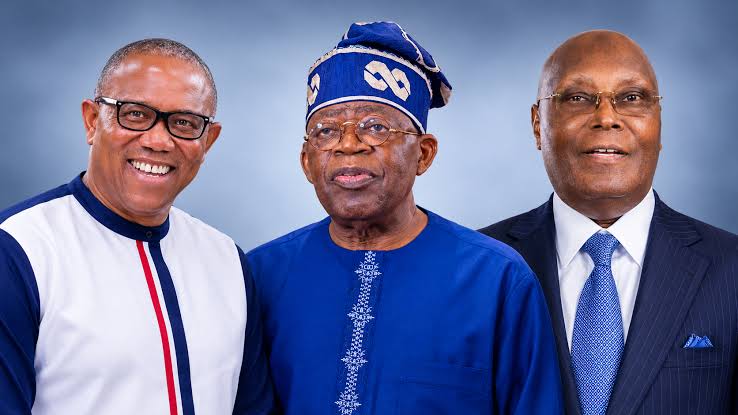
Peter Obi of the Nigeria Democratic Congress (NDC) held a narrow lead in a public mock presidential election simulation run by the Nigeria Election Intelligence System (NEIS) on Saturday, according to figures published on the platform.
With just over half of simulated polling units reporting, Obi stood on 5,775,102 votes (31.5 percent). Bola Tinubu of the All Progressives Congress (APC) followed with 5,612,075 votes (30.6 percent), while Atiku Abubakar of the African Democratic Congress (ADC) recorded 5,471,831 votes (29.8 percent). The margin separating Obi and Tinubu was 163,027 simulated votes.
Neis
NEIS, an independent election data platform, described the exercise as a stress test of its infrastructure and systems ahead of the real 2027 general elections. “Most importantly, this is a SIMULATION meant to stress test our infrastructure and system engines — it’s not an endorsement of any candidate or political party,” the organisation stated when announcing the event.
The simulation covered more than 80,000 polling units and included presidential, Senate and House of Representatives races. At the time of the latest update, 90,602 of 176,846 polling units (51.2 percent) had reported, with all wards accounted for. Simulated turnout stood at 39.2 percent, based on 18,806,044 accredited voters and 18,335,722 valid votes.
On the constitutional requirement of at least 25 percent of votes in two-thirds of Nigeria’s 36 states and the Federal Capital Territory (25 jurisdictions), Tinubu and Abubakar both reached 23 jurisdictions while Obi stood on 19, according to the NEIS dashboard.
Neis
Other candidates in the mock results included Seyi Makinde of the Allied Peoples Movement (APM) on 964,546 votes (5.3 percent). The platform noted that the leaderboard was designed to shift dynamically during the exercise.
NEIS has stressed that its figures are generated for testing purposes only and do not represent actual votes or official results. The Independent National Electoral Commission remains the sole authority for conducting and declaring the outcome of Nigeria’s elections. The next presidential election is scheduled for January 2027.
The mock exercise forms part of NEIS’s broader preparations, which also include civic agent training and the planned rollout of additional collation features in the coming weeks.
Suggested short video narration / script (for ANN video package, approx. 60–75 seconds):
[Visuals: NEIS dashboard graphics, maps of Nigeria showing simulated lead by zone, file footage of candidates, polling unit graphics]
VO:
In a public mock presidential election simulation run by the Nigeria Election Intelligence System, Peter Obi of the NDC held a slim lead on Saturday.
With just over half of simulated polling units in, Obi stood on 31.5 percent of the vote — ahead of Bola Tinubu of the APC on 30.6 percent and Atiku Abubakar of the ADC on 29.8 percent.
The gap between Obi and Tinubu was just over 163,000 simulated votes.
NEIS made clear the exercise was strictly a stress test of its systems and not an endorsement of any candidate or party.
On the constitutional 25-percent spread requirement, Tinubu and Abubakar both reached 23 jurisdictions while Obi stood on 19.
The platform stressed that these are generated figures only. The real presidential election is set for January 2027, with INEC as the sole official authority.
From Lagos, this is Angel Network News.
