

Recently, the Supreme Court of Nigeria in a landmark ruling approved the use of hijab (the Islamic veil) for female Islamic students of all levels of education in Nigeria. The Supreme Court had, on June 17, 2022, in a split decision, ruled that female Muslim students have the right to wear the hijab to school. Thus, ending a protracted legal tussle, which started in 2014 when the Muslim Students Society of Nigeria, MSSN, and some secondary school pupils sued the Lagos State Government for preventing them from wearing the veil to school as demanded by their religion. Justice Grace Onyeabo of the Lagos State High Court had upheld the state government’s prohibition of the hijab on October 17, 2014 but the Lagos Division of the Court of Appeal reversed the lower court’s ruling on July 21, 2016. The Supreme Court’s ruling in favour of the Muslim litigants brings the issue to a close.
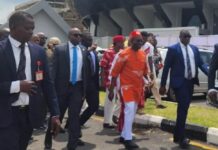
In protest to the court ruling, Barrister Omirhobo has won to court, a costume combining the regalia of African traditional religion with his legal outfit. His action has sparked controversies even among his fellow learned colleagues. Just yesterday, I chanced upon a clip of a group of lawyers berating Barrister Omirhobo for dressing like a traditional witch doctor to court. Unfortunately, like most public debates in Nigeria, these lawyers seemed to have missed the point on Omirhobo’s protests. The important question they should have asked was “why did he start coming to Court dressed as he is currently started doing?” Unfortunately, the “why” was left out of the discussion?
The Sticking Point in Omirhobo’s Controversy
The debate ignited by Barr. Omirhobo’s funny dress code is directly connected to the Supreme Court judgment on hijab. However, the question behind the controversy is very fundamental and goes right to the heart of the identity of the Nigerian state. The question is not simply about dressing code but about deciding whether Nigeria is a secular or an Islamic country. This is why those who laugh at Omirhobo do so without realizing that what he is pursing is fundamental to resolving every single problem has Nigeria today. For instance, the lynching of Miss Yakubu Deborah in Sokoto few weeks back and the implementation of Sharia laws in northern Nigeria are fundamentally connected to the question on whether Nigeria is a secular or an Islamic state. Also, the Boko Haram terrorists fighting to make northern Nigeria Islamic are questioning the identity of the country. Above all, the marauding killers’ herdsmen killing and maiming people across the length and breadth of this country see Nigeria as their Islamic patrimony. Therefore, until the issue raised by the Supreme Court judgment is resolved, Nigeria’s most fundamental problems will never go away. Resolution for this fundamental question is what Barr. Omirhobo is demanding from the Nigerian judiciary.
The Position of the Nigerian Constitution
Is Nigeria secular or Islamic? Under the 1999 Constitution, Nigeria has no state religion. While some interpret this to mean that Nigeria is “a secular state”, others insist that our country is a “multi-religious state”. “Secular” state means that there is separation of church (or mosque) and the state. This is to prevent the country from sliding into a theocracy that could result in the violation of the religious rights of disadvantaged groups.
The argument is that if everybody is allowed to carry their religious baggage into public establishments like schools, the police and the army, the concept of uniformity will be defeated and interfaith rivalry will be pronounced. On the other hand, multi-religious presuppose that the religious rights of citizens should be accommodated by the government to allow citizens enjoy their full right to practise their faiths as guaranteed by the constitution itself. It is on the basis of this that Muslim leaders brought Islamic traditions like pilgrimages and wearing of religious toga into government business and schools.
The Ruling of the Supreme Court
It is obvious that the Supreme Court did not entertain the controversy surrounding the identity of Nigeria on its merit. Sentiments were allowed to win the day. The implication of the Supreme Court judgment is that adherents of other religions now have the right to wear any fashion sanctioned by their religions to public school in Nigeria. Since Islam and Christianity are not the only religions that Nigerians practise, we must be ready to accommodate any form of dressing that students wear to school in the name of religion.
Now that the Supreme Court has permitted Hijab for public schools that are not exclusively recognized as an Islamic School, it should simultaneously make Allowance for children whose parents believe in African Traditional Religion to dress in their traditional attires and costumes to School. Also, if the Court permits a Christian female Lawyer to wear “Scarf” to court, it shouldn’t in anyway prohibit an ATR female lawyer from wearing white cowries on her head to court. After all, what is good for the goose, they say, is also good for the gander.
