

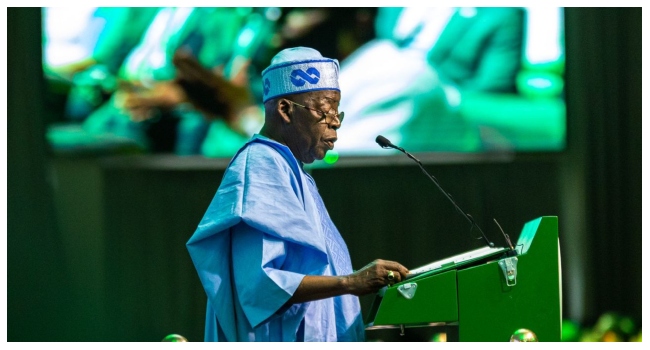
President Bola Ahmed Tinubu has said that powerful interests benefiting from Nigeria’s former exchange rate system and fuel subsidy regime are angry with his administration’s ongoing economic reforms, and in some cases, wish him dead.
The President’s position was conveyed on Wednesday in Lagos during the public presentation of the book “The NADECO Story” written by Chief Ayo Opadokun, alongside an awards ceremony organised by the National Democratic Coalition (NADECO).
Former Ogun State Governor, Olusegun Osoba, who represented the President at the event, said Tinubu acknowledged that his administration had “offended” certain economic interests through the removal of multiple exchange rates and fuel subsidies.
According to Osoba, Tinubu said those benefiting from round-tripping and subsidy-related schemes were unhappy with the reforms.
“As for security, he says I should let you know that he is aware that there is a deliberate attempt to disrupt the peace of this country by people whom he knew he had offended by cancelling multiple exchange rates and by cancelling oil subsidies,” Osoba said.
He added that the President described such interests as those who “would wish him dead,” but insisted he remained committed to restructuring the economy regardless of opposition.
Osoba further relayed that Tinubu expressed determination to continue with the reforms, stressing that his focus was on stabilising the economy and strengthening national security.
The President also noted that the gap between the official and parallel exchange rates had significantly narrowed, which he said reflected progress in the foreign exchange market.
Tinubu, however, cautioned that an excessively strong naira could create new economic distortions, particularly for importers who had already conducted transactions at higher exchange rates.
“In fact, he says he is not going to allow the naira to get too strong.
He does not want to create confusion for those who have bought money at about N1,500 and other goods,” Osoba stated.
The event was attended by several prominent Nigerians, including Nobel Laureate Prof. Wole Soyinka, Dr. Olisa Agbakoba, and the Olubadan of Ibadanland, Senator Rasheed Ladoja, among others.
