





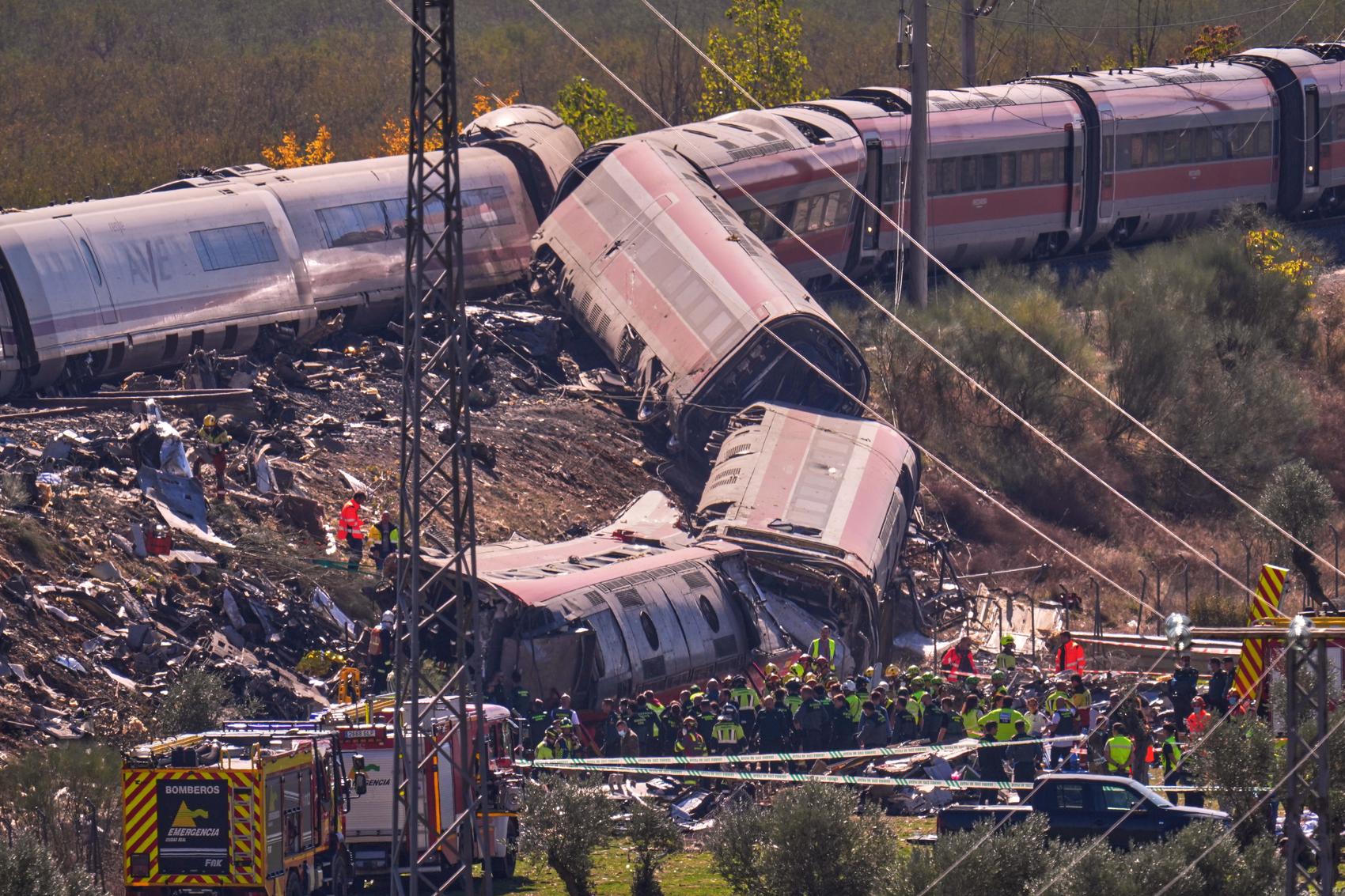
At least 69 people were killed when a high-speed train slammed into a stationary one on the Madrid-Seville line on Wednesday, Spain’s second deadly rail disaster this year and Europe’s worst since 2013.
The collision occurred at about 8:53 a.m. near Urda in Toledo province, about 140 kilometres south of Madrid. A Renfe train carrying around 397 passengers struck the rear of an Iryo service with about 147 people on board that had stopped because of a signalling failure. Several carriages derailed and plunged down an embankment.
Spanish Transport Minister Óscar Puente said a computer failure had disabled the LZB train-control system along a 63-kilometre stretch, automatically stopping several trains. Controllers at the Adif operations centre in Madrid then issued what he described as an “inexplicable” order allowing the Renfe train to proceed without speed restrictions.
“My duty now is not to focus on discussing whether I will remain in office, but on solving the problem, determining exactly what happened and providing clear explanations,” Puente said on Friday, rejecting calls for his resignation.
Around 80 to 110 people were injured, with about 15 in critical condition. Rescuers continued searching the wreckage on Thursday and Friday as identification of victims proceeded slowly.
The crash, which followed a January accident on the same line that killed 46 people, has upended the campaign for the November 29 snap election. Prime Minister Pedro Sánchez’s Socialists had sought to focus on housing and social issues. Opposition leaders have instead zeroed in on infrastructure safety and government competence.
Popular Party leader Alberto Núñez Feijóo said: “This is the moment to respect the dead, the injured and their families. That does not mean we will ignore the fact that Spaniards are asking tough questions that demand answers.”
Far-right Vox leader Santiago Abascal was more aggressive, accusing Sánchez of “criminal handling of affairs” and calling for voters to reject the government on election day.
Spain has declared three days of national mourning. The tragedy has intensified scrutiny of the high-speed network, long regarded as a national success, and raised questions about the pace of modernisation from the older LZB system to newer European standards.
