




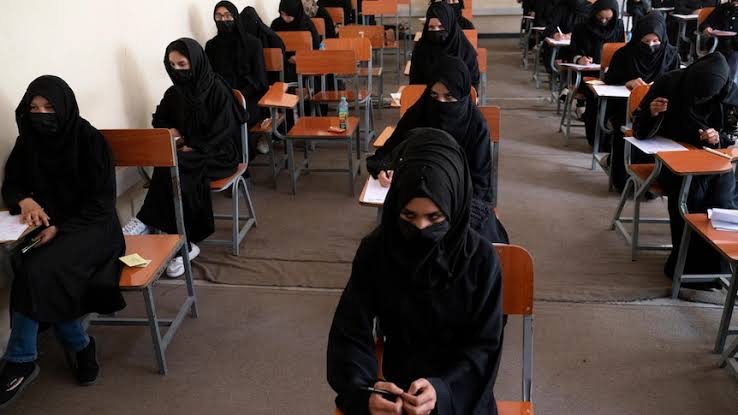
The Taliban have announced the closure of universities for women in Afghanistan, according to a letter from the higher education minister.
The statement said the move is until further notice. It is expected that the new restriction will take effect immediately. Afghanistan’s Taliban-run higher education ministry has said that female students would not be allowed access to the country’s universities until further notice.
According to Aljazeera, a letter, confirmed by a spokesperson for the higher education ministry on Tuesday, instructed Afghan public and private universities to suspend access to female students immediately, in accordance with a Cabinet decision.
“You all are informed to immediately implement the mentioned order of suspending the education of females until further notice,” said a letter issued to all government and private universities, signed by the Minister for Higher Education, Neda Mohammad Nadeem.
The latest Taliban restriction on female education is likely to raise concerns in the international community.
The spokesman for the ministry, Ziaullah Hashimi, who tweeted the letter, confirmed the order to several news agencies including AFP and the Associated Press.
Taliban released two detained Americans
The Taliban released two American nationals held in Afghanistan on Tuesday in what appears to be a “goodwill gesture”, Mr Price said, adding that they will soon be reunited with their loved ones.
Speaking at a daily press briefing, Mr Price said Washington was continuing to raise with the Taliban the need to release any US nationals detained in Afghanistan but declined to provide who they may be and how many people may be held there.
The release was not part of any larger prisoner swap, and no money changed hands, he told reporters.
“We are providing these two US nationals with all appropriate assistance. They will soon be reunited with their loved ones and we are absolutely gratified to see that,” Mr Price said.
“We understand this, or at least the Taliban characterised this to us, as a goodwill gesture.”
The pair was released three months after the Taliban freed Mark Frerichs, an American engineer, in an exchange for Bashir Noorzai, a convicted drug smuggler held by the United States since 2005 and granted clemency by US President Joe Biden.
A new report released on Wednesday by Save the Children listed Afghanistan as the worst country in the world to be a child with an estimated 14 million children in need of aid.
The report said children were suffering from poverty, hunger, “political neglect and lack of funding for humanitarian responses”.
Chris Nyamandi, Country Director of Save the Children Afghanistan, said millions of children were at risk of severe malnutrition and life-threatening illnesses.
“It’s a humanitarian catastrophe on a scale the country has never seen before, and it’s only set to get worse,” he said.
“Families are taking desperate measures to survive — sending their children to work or surviving on bread alone.”
The US does not formally recognise Afghanistan’s ruling Taliban, who took power from the government after US forces withdrew in August 2021.
Despite sanctions by the United Nations and member states, the UN Security Council adopted an exemption last year to allow the UN and aid groups to deal with sanctioned Taliban leaders to meet humanitarian needs.
However, UN aid chief Martin Griffiths told the Security Council that while this move had “helped save lives”, it was not enough.
Mr Griffiths said 97 per cent of Afghans live in poverty, two-thirds of the population need humanitarian aid to survive, 20 million people face acute hunger and 1.1 million teenage girls remain banned from school.
