





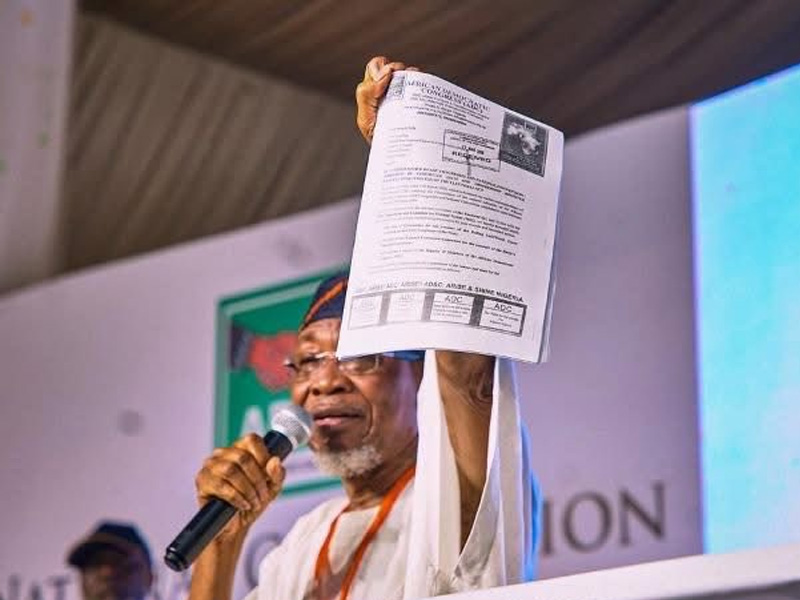
The Court of Appeal, Abuja Division, on Thursday adjourned the hearing in an appeal challenging the deregistration of the African Democratic Congress (ADC), Accord Party, and four other political parties until July 7.
The appellate court rescheduled the hearing to allow parties to file and exchange their briefs of argument before the substantive hearing
The affected political parties are the ADC, Action Peoples Party (APP), Action Alliance (AA), Accord Party (AP) and Zenith Labour Party (ZLP).
At the proceedings, counsel to the Accord Party, Musibau Adetunbi, SAN, informed the three-member panel of justices that the record of appeal and the final judgement of the Federal High Court were only obtained on Monday and subsequently transmitted to the Court of Appeal.
Mr Adetunbi thereafter sought a short adjournment to enable parties to file and exchange their processes
The application was not opposed by the other parties, prompting the presiding judge, Justice Abba Mohammed, to adjourn the matter until July 7 for hearing.
Although Mr Adetunbi requested three days to file and exchange briefs of argument, Justice Mohammed said some members of the panel would be out of Abuja for a period of one week for a special session and consequently fixed July 7 for the hearing.
Justice Peter Lifu of the Federal High Court had earlier ordered the Independent National Electoral Commission (INEC) to deregister the ADC and four other political parties for failing to meet constitutional requirements in previous elections.
Despite the opposition from INEC that the affected parties had met the constitutional requirements with evidence in support of their position, the trial judge ordered the deregistration of the affected parties.
In the judgment, Justice Lifu held that the five parties failed to meet constitutional requirements to justify their continued existence and participation in future elections.
He consequently barred INEC from recognising the parties, accepting their candidate nominations, or giving effect to their activities regarding the 2027 general elections.
The judge also restrained the parties from parading themselves as registered political parties.
Justice Lifu held that there was merit in the suit instituted by the National Forum of Former Legislators (NFFL).
The NFFL had asked the court in its suit to determine whether INEC had a constitutional obligation to deregister political parties.
This, they said, was with particular reference to parties that failed to meet the electoral performance thresholds prescribed under Section 225A of the 1999 Constitution (as amended), the Electoral Act 2022 and relevant INEC regulations.
The plaintiff contended that the five political parties consistently failed to meet the constitutional benchmarks required to retain their registration.
According to the NFFL, the requirements include securing at least 25 per cent of votes in a state during a presidential election or winning at least one elective seat at the national, state or local government level.
The group argued that the affected parties performed poorly in the 2023 general elections and subsequent by-elections, failing to win seats at critical levels of government.
It maintained that their continued recognition as political parties was unlawful and undermined the integrity of Nigeria’s electoral system.
INEC, however, opposed the suit, insisting that the parties could not be deregistered because they won various seats in state legislatures and the National Assembly.
The commission supported its position with certificates of return issued to candidates of the affected parties who won elections.
On June 16, however, the Court of Appeal ordered a stay of execution of the judgement of the lower court, holding that it was delivered in disobedience of its earlier directive that proceedings in the matter be suspended pending the determination of an appeal before it.
In a unanimous decision, the three-member panel led by Justice Mohammed restrained INEC from implementing the judgement pending the determination of the substantive appeal.
The appellate court accused the trial judge of proceeding with the case despite its May 22 order directing that further proceedings be suspended.
It held that Justice Lifu’s action amounted to an affront on the hierarchy of courts.
“Courts are enjoined to protect their integrity. This court has supervisory authority over the trial court; the decision of the lower court to proceed with the judgement despite the express order of this court is a brazen violation of the hierarchy of the court and the 1999 Constitution
“This court has the duty to invoke its powers in ensuring that its orders are made.
“The application for a stay of execution is hereby granted; the enforcement of the judgement is stayed,” the justices of the appellate court held.
(NAN)
