





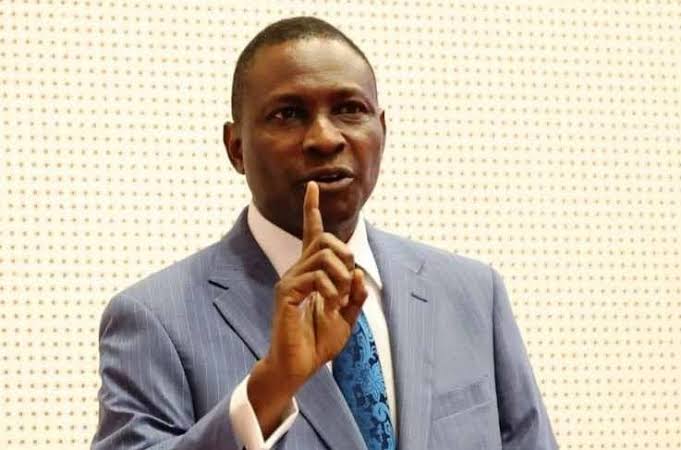
Anti-graft agency has delivered a stark indictment of the country’s university system, claiming that about 60 percent of students in Nigerian higher institutions are involved in internet fraud — a disclosure that has drawn sharp reactions from political leaders, student groups, and the public alike.
A Bombshell From the EFCC Chair
Ola Olukoyede, Chairman of the Economic and Financial Crimes Commission, made the disclosure on Tuesday at the opening of the 8th biennial conference of the Committee of Pro-Chancellors of State-Owned Universities in Nigeria, held in Kano, themed “Unlocking the Potentials of Artificial Intelligence: University Governance, Internationalisation and Rankings.”
“My research in the last one year has shown that about six out of 10 students in our universities are into cybercrime. It is a very disturbing situation,” he said, blaming the trend on deep-seated structural problems within the university system, including weak oversight and poor accountability mechanisms.
Olukoyede also alleged that some students involved in internet fraud had placed university lecturers on their payroll, a practice he said was eroding academic integrity and exposing deeper corruption within tertiary institutions.
He pointed to a major operation as evidence of the scale of the problem. Citing a Lagos enforcement exercise, he disclosed that 792 suspects linked to a transnational cybercrime syndicate were arrested, with a significant number of those apprehended being undergraduates — and that the operation was powered by artificial intelligence tools that exposed the sophistication of cybercrime networks operating within and beyond Nigeria.
The EFCC chairman also flagged the growing trend of “Yahoo Plus” — where internet fraud is allegedly combined with fetish practices — warning that it posed serious moral and security risks.
“A university that lacks financial accountability cannot credibly train future professionals. The integrity of our universities is a matter of national security,” Olukoyede stressed, calling on pro-chancellors to deploy AI-driven governance systems and strengthen collaboration with law enforcement.
Obi: “We the Leaders” Are to Blame
Former Labour Party presidential candidate Peter Obi responded swiftly, framing the EFCC’s claims not as a student problem but as a verdict on Nigeria’s leadership class.

“The worrisome statement by the Chairman of the EFCC that six out of every 10 Nigerian university students are involved in ‘419’ is deeply troubling and must not be taken lightly,” Obi said in a statement released on Wednesday.
He warned that with an estimated 2 to 2.5 million university students in Nigeria, the figures would amount to a national emergency. “If indeed about 60% of them — roughly 1.4 million young people — are involved in fraud, then we are not just facing a crime issue; we are confronting a serious moral and systemic failure,” he said.
Obi placed the primary responsibility squarely on those in power. “When a system appears to reward wrongdoing, when integrity is not upheld, and when those in leadership are associated with allegations of forgery and dishonesty without consequence, it sends a dangerous message,” he said.
“If we do not demonstrate integrity at the top, we cannot expect it at the bottom,” the former Anambra governor added, calling for a national rebuilding of values and an environment that rewards honesty, discipline, and hard work.
Students Push Back Hard
Nigeria’s apex student body was equally outspoken — but its fire was directed at the EFCC chairman himself.
The National Association of Nigerian Students condemned the remark as “not only unsubstantiated in its public presentation but also grossly insensitive, damaging, and unbecoming of a public office holder entrusted with national responsibility,” saying the claim unfairly criminalises the overwhelming majority of hardworking, law-abiding Nigerian students.
NANS also turned the allegation back on the EFCC, questioning whether the statistics exposed the agency’s own failures. “Does this assertion imply that cybercrime has become more prevalent than in previous years under the watch of the EFCC and other relevant government agencies? Or does it suggest that the numerous interventions, campaigns, and enforcement strategies deployed over time have failed to yield measurable results?” the association queried.
The body called on Olukoyede to either provide verifiable data and proper context to substantiate the claim, issue a public clarification, or retract the statement entirely in the interest of fairness, national image, and youth development. “Nigerian students are not criminals. They are innovators, scholars, leaders, and the backbone of our nation’s future,” NANS declared.
